Showing posts with label Passion. Show all posts

Friday, April 6, 2012

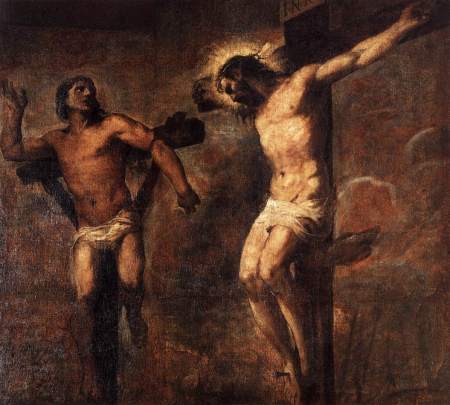
They All Abandoned Him (Good Friday)


“They all abandoned him”
Good Friday
12:00 noon Good Friday Liturgy with Adoration of the Cross
Homily Delivered at Trinity Episcopal Church
Ashland, Oregon
Isaiah 52:13-53:12; Hebrews 10:16-25; Psalm 22; John 18:1-19:42

God, take away our hearts of stone
 and give us hearts of flesh. Amen.

One of the saddest elements of the passion stories is summed up in a line from Mark’s Gospel that is repeated in Matthew’s, describing the disciples’ reaction to the arrest of Jesus, “And they all forsook him and fled” (Mark 14:50; cf. Matthew 26:56).   All four Gospels agree that several of Jesus’ women disciples watched on from a distance as he suffered on the cross, and then sought to care for his body after his death.  And John’s Gospel insists that the founder of that Gospel’s community, the beloved disciple, also stood by the cross with Jesus’ mother.  But apart from that, all Jesus disciples abandoned him, including St. Peter, whose initial effort to follow Jesus ends in his denial of even knowing him in all four Gospels. 

The fact is, the disciples had always been skeptical of Jesus, and wary of his strange ways of thinking and behaving.  At turns in the Gospel stories of his life, they are “variously enthralled, mystified, bemused, apprehensive, and confounded” (A Keeper of the Word: the Selected Writings of William Stringfellow, ed. Bill Wylie Keller; Eerdmans: Grand Rapids, 1994, p. 394.)

Earlier, even when the disciples seemed to be doing the best, they fail miserably.  When Peter first confesses Jesus as Christ, he immediately spoils the moment of faith by arguing with Jesus over what it means to be a Messiah, insisting that Jesus cannot suffer or die, lest the kingdom not come.  “Get behind me, Satan,” is Jesus’ response.   Peter seems to be rehearsing for Good Friday. 

We see it again and again.  The disciples go out, charged by Jesus to preach the arrival of the Kingdom and heal the sick.  Sometimes they succeed, but there are several stories where they fail, and where Jesus’ response is to gently chide them for their lack of trust in God.   Peter sinks in the waves as he tries to follow Jesus’ beckoning as he walks on the sea.  They doubt Jesus’ care for them during the tempest on the sea.  The sons of Zebedee, James and John, try to set themselves up with special places of honor beside Jesus, and all the other disciples argue with them over it.  When the two go with Peter to accompany Jesus to the Mount of Transfiguration and see there the wondrous revelation of who Jesus truly is, all Peter can do is to propose building three small shrines commemorating the event, “because he did not know what he was saying.”  They repeatedly misunderstand parables and sayings of Jesus, even when he speaks in relatively clear terms.  Even on the evening of the last supper with Jesus, on Maundy Thursday, the disciples are still arguing with each other over their relative rank.  

Holy Week sees the problem condensed and concentrated.  The disciples’ acclamation of Jesus as the coming David on Palm Sunday quickly turns into worry at what they think are his erratic acts that week, the cursing of the fig tree, the cleansing of the Temple, his strange declaration at their last meal together that the bread and wine are not the Passover’s “Bread of Affliction” or “Cup of Blessing,” but rather his own body and blood, broken and poured out for them.  By the time his inner circle accompanies him to Gethsemane, they are exhausted, worn out, and cannot even stay awake to prayer with him. 

And these people were Jesus’ friends and family!  As William Stringfellow writes, “…if one goes no further than this, there is a warning for people now in these New Testament reports of the skepticism or incredulity of the disciples (and of Jesus’ family) despite their intimacy with Jesus.  This should be enough to render people wary of huckster preachers or celebrities evangelists who assert that mere intimacy with Jesus of an intense, private, or exclusive nature is faith.  This is a fascinating, tempting, simplistic, but unbiblical doctrine, and multitudes are seduced by it into fancying that to be, somehow, in the presence of Jesus is so compelling and so positive an experience that doubt of all sorts is dispelled quickly, conclusively, as if magically.  Yet there is no basis in the New Testament for any such supposition or delusion; on the contrary, for all their unique experience in the company of Jesus, the disciples did not believe him or believe in him.  What seems most surprising and crucial, furthermore, is that the disbelief of the disciples persisted even after the resurrection” (ibid., 396-7.)   

The disciples in these stories are in a way symbols for all disciples, for all of us.  These stories of abandonment, incredulity, and obstinance are about us.  
How often do we let our fear let us ignore what Jesus tells us in our conscience? 

How often do we let our desire for control and security, at least the semblance of control and security, govern our choices even when Jesus calls us otherwise? 

How often do we compartmentalize our lives—faith and religion over here, and politics, economics, finances, social status, and amusements over here? 

They all abandoned him.  We all abandon him. 

Dutch renaissance poet Jacobus Revius wrote the following poem on the occasion of Good Friday: 

He Bore our Anguish

It was not the Jews, Lord Jesus, who crucified you,
Nor the traitors who dragged you to the law,
Nor the contemptuous who spit in your face,
Nor those who bound you, and hit you full of wounds,
And it was not the soldiers who with evil hands
Lifted up the reed, or the hammer,
Or set that cursed wood on Golgotha,
Or cast lots for your robe;
It is I, O Lord, it is I who have done it,
I am the heavy tree that overburdened you,
I am the rough hands that bound you,
The nail, the spear, and the cords that whipped you,
The bloodied crown that tore your head;
All this happened, alas! for my sins.  (tr. Charles D. Tate, Jr.)

Lord Jesus Christ, you gave your body over to be whipped and pierced, your face to be spit upon, and your life’s blood to be poured out for our sake, to bring near your Father’s Reign.  Mercifully grant us grace to accept the sufferings that are ours, and sustain us that we might follow you as faithful witnesses and proclaim the joy of your kingdom.  For your mercy’s sake we pray, Amen. 

Monday, April 2, 2012

Seven Last Words of Christ (Meditations)


Seven Last Words of Christ
String Quartet Sonatas  Opus 51  
Joseph Haydn
Performed by the Ariana String Quartet
Trinity Episcopal Church
Ashland, Oregon
Monday 2 April 7:00 p.m.

“Hope in Affliction”
Reflections on the Seven Last Words
Father Anthony Hutchinson
  
MEDITATIONS

Introduzione: D minor — Maestoso ed adagio

Seven Words of Christ hanging on the Cross.  Seven, the number of perfection.  The number of completion, of rest after creation, Sabbath after work, death after life. 

Seven sayings from Four Gospels, told by Ministers of the Word a generation later, whose tellings are on occasion at odds. 

In the first Gospel written, gentile Mark, and that of his Jewish editor and adapter, Matthew, a single word of seeming despair, a quote from a Psalm of ultimate hope and trust in God’s goodness:
My God, My God, why have you forsaken me?

In the Gospel of Gentile Physician and historian Luke, three words: 

a prayer for forgiveness for the torturers
Father forgive them, for they know not what they do

an assurance of love and hope for a fellow sufferer who expressed compassion,
Truly, I say to you, today you will be with me in paradise

and a dying child’s prayer of trust in its parent:
Father, into your hands I commit my spirit (last words)

In the final Gospel, John, who stresses for his beloved community at all cost the divinity of Jesus, three words:

A plea to care for Mary his mother and honor her as our own:  
Woman, behold [my disciple] your child: [disciple,] behold your mother  

A croaking gasp of need and oneness with all who yearn for refreshment
I thirst

A dying declaration that the Jesus’ suffering is over. 
It is finished

Seven words in Four Gospels, traditionally understood as expressing theological ideas.   But all these seven words are words of hope in affliction, faith amid pain, and solidarity with suffering humankind.


     I.         Sonata I: B-flat major — Largo 
Pater, dimitte illis, quia nesciunt, quid faciunt.
Father, forgive them, they know not what they do.

Jesus is a victim, but so too are those who torture him.  They are bound in system of discipline and power that requires their brutality, lest they be brutalized for disobedience and insubordination. 

But the victim of violence and injustice is not the same as the victim perpetrator of violence and injustice.  A line divides guilt and innocence.  But Jesus sees through justice and injustice, fairness and abuse, guilt and innocence.  He recognizes his torturers too as God’s creatures, bearing the image of God, no matter how badly twisted.  And he wishes them forgiveness for their guilt, healing for their own victimhood. 

Here is forgiveness in affliction.  

                    II.         Sonata II:  C minor, ending in C major — Grave e cantabile
Hodie mecum eris in Paradiso.
This day you shall be with me in Paradise.

Jesus is suffering the death of a traitor and subversive.  His crime is written, tongue-in-cheek, as a title on his Cross, “King of the Jews,” the hoped-for David who would bring freedom to Israel. Crucified with him hang two random political rebels, terrorists who fought the Roman Imperial Power and lost.  One mocks Jesus along with the crowd and soldiers,  “If you really are the coming King David, then go ahead, save us now.”  The other scolds him, “Have you no fear of God?  You are suffering just as he is, but the two of us actually did something to deserve this. This poor man did nothing!”  A line divides guilt and innocence, and we are guilty.  Then in compassion, not mockery, he adds, “Please sir, when you come into your kingdom remember me and be kind.”  Jesus, in equal compassion replies, “It is on this very day that the two of us will meet in the garden of delights.” 

Here is comfort to others in affliction. 

     III.         Sonata III: E major — Grave
Mulier, ecce filius tuus.
Woman, behold thy son.

When he began his public preaching, Jesus was accused of abandoning his Mother and siblings.  They thought he had gone mad when he left them to follow John the Baptist and then pursue his prophetic calling.  “Who are my true mother and brothers?” he asked at one point, answering, “those who seek God.”  Now dying, and seeing the mother he had thus left behind to follow God standing in shock and grief at the sight of her dying son, Jesus is concerned for her suffering, as well as her wellbeing.  This new family of his, the community of those following him, is what he bequeaths to his Mother:  “Woman, behold my disciple, now your son.  Disciple, behold this woman, now your mother.”     

Here is concern for others, for family and friends, in the face of death. 

   IV.         Sonata IV: F minor — Largo
Deus meus, Deus meus, utquid dereliquisti me?
My God, My God, why have you forsaken me?

Throughout his life, Jesus prayed and quoted the Psalms.  Here in his moment of mortal need, he begins to sing in his native tongue Aramaic Psalm 22, אלהי אלהי למא        שבקתני [ēlâhî ēlâhî lamâ šabaqtanî]. It is a song of distress, but not one of despair.  It is a song of hope and trust in God even in the worst affliction.  

1    My God, my God, why have you forsaken me?
   and are so far from my cry
   and from the words of my distress?

2    O my God, I cry in the daytime, but you do not answer;
   by night as well, but I find no rest.

3    Yet you are the Holy One,
   enthroned upon the praises of Israel.

4    Our ancestors trusted in you;
   they trusted, and you delivered them.  …

19  Save me from the sword,
   my life from the power of the dog.  …

23  … [The Lord] does not despise nor abhor the poor in their poverty;
neither does he hide his face from them;
   but when they cry to him he hears them.  …

25  The poor shall eat and be satisfied,
and those who seek the Lord shall praise him …

29  My soul shall live for him . . .

30  … a people yet unborn [shall know]
   the saving deeds that he has done.

Here is hope and trust even when God seems to have abandoned us to horror. 

V.         Sonata V:  A major — Adagio
Sitio.
I thirst.

Jesus, when he meets the Samaritan woman at Jacob’s well early in John’s Gospel, promises himself as the living water.  “The one who drinks it,” he says, “will never be thirsty again. It will spring up from within, and become an unending source of flowing water.”  On the cross, as Jesus sings Psalm 22, he says,

15  My mouth is dried out like a pot‑sherd;
my tongue sticks to the roof of my mouth;
   and you have laid me in the dust of the grave.

“I thirst,” Jesus says, and they give him soured wine on a sponge to drink.  Later, to kill him, they pierce his side with a lance, and water flows from his side, mixed with his blood. 

“I thirst,” says the Living Water, the spring of God’s grace, who thus marks himself as one with all who suffer thirst and seek refreshment. 

Here is solidarity in bitter need. 


VI.         Sonata VI:  G minor, ending in G major — Lento
Consummatum est.
It is finished.  John 19: 30

“It is finished” Jesus moans in relief as blood loss, shock, and slow suffocation bring him near death, the end of his suffering.  “Tetelestai” he says in the Greek of John’s Gospel.  “The telos, the purpose or end that God intends, is accomplished.”  “I have reached the end of the path God gave me.”  God does not want his creatures to suffer, and does not want Jesus to suffer.  Death is relief from suffering. Though horror is all about, Jesus sees God’s good purpose fulfilled.  “It is finished.  Thanks be to God.” 

Here is relief in endings. 


VII.         Sonata VII: E-flat major — Largo
In manus tuas, Domine, commendo spiritum meum.
Into your hands, O Lord, I entrust my spirit.  Luke 23:46

Jesus in dying, quotes another Psalm of his people, Psalm 31.  He abandons himself to the God who seems to have abandoned him. 

1    In you, O Lord, have I taken refuge;
let me never be put to shame;
    deliver me in your righteousness.

2    Incline your ear to me;
    make haste to deliver me.

3    Be my strong rock, a castle to keep me safe,
for you are my crag and my stronghold;
    for the sake of your Name, lead me and guide me.

4    Take me out of the net that they have set for me,
    for you are my tower of strength.

5    Into your hands I entrust my spirit,
    for you have bought me back,
    O Lord, O God of truth.

Here is hope by emptying oneself.  Here is trust in suffering.  Here is light in the darkness. 


Conclusion: C minor — Presto e con tutta la forza
Il terremoto (the Earthquake)

Seven words in Four Gospels.  In them, Jesus (as well as he can) comforts a fellow prisoner being executed, tries to arrange his affairs and comfort his Mother, asks for a drink of water, sings two psalms praising God, hoping against hope, trusting against trust, and dies. 

Here is hope within suffering, compassion in affliction, trust in abandonment, love within horror. 

Lord Jesus Christ, you stretched out your arms of love on the hard wood of the cross that everyone might come within the reach of your saving embrace: So clothe us in your Spirit that we, reaching forth our hands in love, may bring those who do not know you to the knowledge and love of you; for the honor of your Name. Amen.

Saturday, May 14, 2011

A Chasm Bridged (Easter 4A)


A Chasm Bridged
15 May 2011
Fourth Sunday of Easter Year A
Congregation of the Good Shepherd, Beijing China
10 a.m. Eucharist

Acts 2:42-47; Psalm 23; 1 Peter 2:19-25;  John 10:1-10

God, take away our hearts of stone, and give us hearts of flesh.  Amen

“The hardest thing in my life,” a dear friend once told me, “is that I always feel like I’m such a fraud.  When things are going well, I’m always trying to catch up and make it appear that I’m totally on top of everything.  When things aren’t so good, I seem to spend all my time trying just to appear normal.”   

I think that almost all of us have that feeling on occasion, and it is very debilitating.  It is a great drain on emotional energy to always be feeling behind the curve, trying to catch up, or always trying to stay on top. 

There seems to be built into life itself, as good as life is, a painful disjunction between where we are and where we ought to be, or where we feel we ought to be.

The problem with making coffee in the morning is that you haven’t had your coffee yet and can barely negotiate the fixings and the machinery. 

The problem with looking for your glasses is that you can’t see to find them. 

The problem with pleasure is that there always is a point where it is too much and becomes disappointing or hellish.  Too much of a good thing is a bad thing. 

The problem with marriage is that the attraction that leads us to commit to each other—despite all our desire for autonomy and freedom—can have a mind of its own, and tends to wander after a while. 

The problem with trying to not be so much a fraud is that you have to fake it so much.

The problem with making progress in spirituality is that you all too soon notice it and become very proud of it, and immediately lose it, or, worse, see it twisted into something ugly and unrecognizable.     

The problem with trying to put away bad behavior is that it always seems to crop up again, sometimes in much worse form.

The problem with trying to live ordered lives is that life just can be so damned messy.

I’m not saying that life isn’t good.  It is good, and sweet indeed.  All I am saying is that for whatever reason, there seems to be built into the very structure of our lives a gap between the is and the ought, between how things are and how they ought to be, between what we are and how we should be.   

In the Hong Kong subway, there are little signs pointing between the station platform and the opened doors of the trains.  They say, “mind the gap.” 

The gap I am talking about is much bigger, and so pervasive we cannot “mind” it.   It is the chasm between what we desire and what we fear, what we hope for and what we dread.  In the story of Lazarus and the Rich man, it is the “great gulf fixed” between Abraham’s bosom and hell.  The chasm is found beneath and in almost everything in life. We see it in arguments, in disappointments, in unfulfilled hope, ruined expectation, and spoiled esteem.  We experience it in dissatisfaction, when we feel shame, when we taste guilt.  Law calls it a crime.  Morals call it sin

Trying to lower our standards to conform to our behavior doesn’t get rid of the gap, it just hides it for a while.  Trying to get rid of all desire, as Buddhism teaches, is itself still a form of trying. Resignation to the unacceptable is a recipe for no progress, either in society or in personal life. Careful efforts at following rules and written prescriptions of how things ought to be, whether in the Torah, the Quran, or a Christian Bible interpreted by the letter, may make things better, but only for a while. No matter how hard we try, the ideal always seems to retreat, like the horizon line, and the chasm between where we are and where we should be remains as great as ever.  

And therein lie the roots of cynicism, pessimism, and despair, despite all the good we see in our life.  The problem with moral improvement is that we fail.  The problem with health is that we eventually get sick.  The problem with living is that we all die. 


Today is the fourth Sunday after Easter.  In the Western Church’s calendar, it is called “Good Shepherd Sunday.” Note all the readings about shepherds.  The traditional collect or opening prayer for this Sunday is: 


O God, whose Son Jesus is the good shepherd of your people: Grant that when we hear his voice we may know him who calls us each by name, and follow where he leads; who, with you and the Holy Spirit, lives and reigns, one God, for ever and ever. Amen. 
Today’s reading from 1 Peter describes Jesus as our shepherd because he, “suffered for you, leaving you an example, so that you should follow in his steps. When he was abused, he did not return abuse; when he suffered, he did not threaten; but he entrusted himself to the one who judges justly.  Christ himself bore our sins in his body on the tree, so that, free from sins, we might live for righteousness.”
 
I was raised in a tradition that taught that the reason Jesus had to die on the cross was to “pay for our sins.”  God was just and we all deserved punishment and death; God the Father sent Jesus in love and mercy so that he could take our place.  And all we have to do is have faith in Jesus, repent, and follow him.  And then we won’t suffer the punishment for our sins.  


As a result, whenever I heard a scripture like, “Christ died for us,” “he bore our sins in his body on the cross,” “so that you, free from sin, might live righteously,” I heard only the doctrine of transferred punishment.  The problems in such a view never occurred to me until I was much older.  One of my sons, at the time nine years old, asked me, “How can God love us and Jesus?  My Sunday School teacher says he sent Jesus to be die on the cross to pay for other people’s sins. Human sacrifice is wrong.  Punishing the wrong person isn’t fair, even if they agree.  Couldn’t God have just forgiven us, and not kill off his own son?” 

The undivided Christian Church has never defined its doctrine of the atonement. The Nicene Creed says that it was "for us and our salvation" that Christ came down from heaven and became fully human, and that it was “for our sake” that he was crucified. But it does not tell us how this was so.  In one of the earliest recorded statements of Christian faith, St. Paul quotes the tradition he had received from earlier Christians: “Christ died for our sins"  (1 Cor 15:1-5), but again, does not tell us what he means by this. Does it mean, “as a result of how badly we treated him,” or “in order to accept the punishment for our individual violations of God’s Law,” or “in order to correct our tendency to go astray by his good example,” or something else? 

Paul elsewhere gives us a dozen or so vivid images for what Christ did:  he liberated us from oppression, he saved us from danger on the battlefield, he created us anew, he purchased us back out of slavery, he reconciled us to God as one would reconcile friends who had quarreled, he propitiated an angry deity, he declared us innocent as in a court of Law, he transformed us like in the Greek myth of metamorphosis.   He is clearly searching for images and is not completely satisfied with any of them.

Over the ages, the Church has explained the atonement in different ways. For the first four or five centuries, both Eastern and Western preachers simply declared that Christ was a victor:  on the cross he took on sin, death, and hell in a battle, and on Easter beat them all.  Once feudalism had become the main social arrangement where Christians lived, they used its sense of honor based in social rank and began to say that Christ offered the “satisfaction” to a Deity insulted and dishonored by the failings of mere human beings, who could never repay their debt of honor to such a superior.  In the High Middle Ages, secular-leaning scholars like Peter Abelard argued that the example Christ set encourages us to behave better and thus be freed of sin, while the more churchly ones like St. Thomas Aquinas argued for a sacramental view, directly linking Christ’s death on the cross with Holy Communion, which they called the sacrifice of the Mass.  It was only during the Renaissance, with its greater emphasis on the individual; political economy, and legal reasoning, that Christians began primarily explaining atonement as substitutionary punishment.

All of these ideas are simply different ways of describing how Jesus closed for us the gap between how things are and how they ought to be, between what we are, and what God intends.  The different images and doctrines just emphasize different parts of the chasm.  And none is ideal, as my son’s questions revealed. 

Despite how I would have understood it as a younger man, today’s text in 1 Peter says that Jesus died for us and bore our sins in his body on the Cross to serve as an example to us, an idea close to Abelard’s: he died for our benefit by leaving us his example.   

In the person of Jesus, the gap between what ought to be and what actually is was as thin as it possibly could be.  It is because of this thinness of the gap shown in Jesus’ life and teachings, that his disciples interpreted what happened on Good Friday and then Easter morning in the way they did.  The resurrection was the ultimate closing of the gap, bridging of the chasm.

Soon his followers were saying that Jesus had in some way been God made present among us.  They knew that his resurrection showed that his death was not meaningless or random.    Within a decade of his death, they were affirming clearly as Paul reports in the passage I quoted earlier, “Jesus died for us in accordance with the scriptures” (1 Cor 15:3-9), thinking of passages in the Hebrew Bible where a good person suffers wrongly but is delivered by God, thus bringing the wicked to a knowledge of God, and where this is described poetically as the wounds of those who suffer wrongly as a kind of medicine that heals  the wicked.

I have felt the healing and calming effect of Jesus’ victory, of his bridging the chasm.  Christ on the Cross and Christ risen again gives me courage to try again, to not lose hope, whether this is making amendment of life or trying to work for a better world around me.  The sweet comfort and the fierce joy we feel at Jesus’ victory is but a foretaste of a world with the gaps closed, the chasms filled, with all as it should be, all as God intends.  No frauds, no sickness, no guilt, no oppression, no fear.  Just the loving presence that enables us to do and be what we ought. 

Sisters and Brothers of the Congregation of the Good Shepherd:  Happy Good Shepherd Sunday.  May the image of a loving and dedicated herder of sheep, once wounded for his flock, who now brings back the stupid and wandering animals from where they are to where they ought to be help us all have courage and hope.  We need not fear the chasm, or be discouraged by our failings.  Christ the Good Shepherd calls us each by name, lays us on his shoulder, gently, and rejoicing, brings us home, brings us to where we should be.   Thanks be to God. 

In the name of Christ, Amen