Showing posts with label healing. Show all posts

Sunday, October 28, 2012

Take Heart, He is Calling You (Proper 25B)


“Take Heart, He is Calling You”
28 October 2012
Proper 25B
Homily preached at Trinity Episcopal Church
Ashland, Oregon
8:00 a.m. spoken Mass, 10:00 a.m. Sung Mass

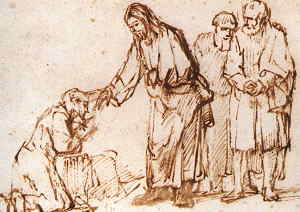
Jesus and his disciples came to Jericho. As he and his disciples and a large crowd were leaving Jericho, Bartimaeus son of Timaeus, a blind beggar, was sitting by the roadside. When he heard that it was Jesus of Nazareth, he began to shout out and say, "Jesus, Son of David, have mercy on me!" Many sternly ordered him to be quiet, but he cried out even more loudly, "Son of David, have mercy on me!" Jesus stood still and said, "Call him here." And they called the blind man, saying to him, "Take heart; get up, he is calling you." So throwing off his cloak, he sprang up and came to Jesus. Then Jesus said to him, "What do you want me to do for you?" The blind man said to him, "My teacher, let me see again." Jesus said to him, "Go; your faith has made you well." Immediately he regained his sight and followed him on the way.
God, take away our hearts of stone, and give us hearts of flesh.  Amen

In the Pixar movie Finding Nemo, a little clownfish named Nemo living near the Great Barrier Reef is netted by a scuba-diving dentist to adorn a tank in his Sydney office.  Nemo’s father, Marlin, is devastated, and he sets out to find his only child with no idea where to go. He meets a blue Tang, Dory, who helps him discover the address of the dentist, despite her own very limited smarts.  Overcoming multiple setbacks and dangers, they are told to find the East Australian Current, which will take them to Sydney harbor.  Gathering their courage, Marlin and Dory risk everything by swimming through a swarm of stinging jellyfish to get into the current.  Suddenly they find themselves carried along in the surge of a great parade of happy sea creatures.  Effortlessly floating in the current, they no longer have to struggle to make their way in the vast, lonely ocean.  A wise sea turtle, Crush, tells them things they need to know to continue their journey.  By the time Dory and Marlin jump out of the current in Sydney, they are very different fish.  Their bewildered fears are now joyful hope.


Transformation!  Change!  From broken to whole, or at least not-so-broken.  From confusion to purpose.  From self-loathing recrimination to confidence and hope.   At one time or another, we all want it, we all need it. 

But our experience and “common” wisdom tells us not to expect it.  So accepting the unacceptable becomes the norm in our lives, or worse, not accepting it, but having to live with it all the same.

Today’s Gospel story says that Jesus can transform the untransformable.   Bartimaeus begins the story blind, rejected, begging on the roadside, and ends up seeing, confident, and walking along with Jesus and the disciples. 

This story in Mark is the only one in the Synoptic Gospels where the name of the healed person is given.  Some take this as evidence of its link to an actual historical event.  Importantly, Mark gives the name twice:  “Bartimaeus, or son of Timaeus.”  Though Mark is writing in Greek, Aramaic was the language Jesus and his followers would have been speaking with each other.   In Aramaic, the word bar means son, and so clearly Bar-Timaeus means “son of Timaeus.”  But Timaeus was a Greek name.  It means “honored one.”  It was not an Aramaic name.  If indeed the blind man was called this, the word in Aramaic would have been bar-tame’ or “son of shame.”  It is not a real name, but an insulting nickname:  “Loser.”  People thought God had punished him for some shameful sin by striking him blind (cf. John 9:34). 

So “Mr. Loser” is not just suffering from the disability of visual impairment.  He is loathed, outcast.  He can get enough food to eat only by begging.  He either believes or suspects that what the others say about him is right.

Caught up in the excitement at news that the healer from Nazareth is passing by, Bar-tame’ begins to shout, as loud as he can, to get Jesus’ attention.  “Have mercy on me, Jesus, son of David!”  This is the most extravagant and dangerous way of talking about Jesus Bar-tame’ has heard on the street, Jesus as the ideal David of the future, the Messiah, who would be a healer.   

The disciples, concerned that their opponents may report them to the Romans’ and get them all arrested, try to shoosh the crazy beggar up.  “Jesus is ministering here!  How dare you interrupt him with your begging! Can’t you get money from any passerby? Leave us alone.” 

Their reaction is understandable.  A strategy of street begging, one I saw often in China and which one encounters occasionally even here in polite, genteel Ashland, is this:  when simple appeals to compassion fail, make yourself so disruptive or obnoxious that people will give you money just to get rid of you.  A meal’s a meal, whether you got it from stirring compassion or provoking disgust and aggravation!

But Mr. Loser just gets louder.  Jesus finally asks what’s going on.  At this, Bar-tame’ balks.  He hadn’t really thought Jesus would stop.

“Take heart! Go, Jesus is calling you!”  The disciples realize that perhaps there is more to this beggar than they thought.  Bar-tame’ casts off his cloak and goes to Jesus. 

In the days before cardboard signs that read “Anything you can do will help,” the beggar’s tattered and filthy cloak was a chief way of appealing for aid.  Bar-tame’ throws off his cloak, and with it all his assumptions about himself, his belief that he really is a loser, all the dysfunctions and fears his disability has wrought.  He casts aside the little bit of security he might feel he has, all to meet Jesus. 

So when Jesus asks him “what do you want,” this one-time son of shame does not say “money” or “bread.”  He asks to be healed.  He asks for his sight.  He asks not to be broken any more. 

And Jesus tells him his faith has already healed him.   Sight is restored.  And Bartimaeus—now a son of honor—starts to walk the Way with Jesus and the other disciples.   

Van Morrison, in his song on hope of recovery from addiction, sings:  
Whenever God, shines his light on me
Opens up my eyes, so I can see
When I look up, in the darkest night
I know everything's gonna be alright.
In deep confusion, in great despair
I reach out for him, he is there.
When I am lonely as I can be,
I know that God shines his light on me.
 
Reach out for him, he'll be there
With him your troubles you can share.
You can use his higher power
In every day and any hour.
Jesus saves and heals the lame
Says you can do it too in Jesus’ name 
He'll lift you up and turn you around. 
He’ll put your feet back on higher ground.
When Dory and Marlin jump into that current, they have to risk all by swimming through the jellyfish.  They have to cast off fear, discouragement, and pessimism.   They have to let themselves be carried away by that stream, part of the joyous parade. 

This is what happens to Bartimaeus in this story. 

It is what happens to us. 

When we encounter Jesus, he transforms us.  If we haven’t been transformed, we just have not encountered him.  Whether sudden or gradual, transformation is a sign of having met Jesus. 

And it’s not about how we feel, whether we think we’ve been changed, or whether we can work up a psychological state that some call “belief.”  Though it’s about real risk, it’s usually not all that dramatic.  Today, we usually encounter Jesus in his body, the Church.   We encounter him in the Church’s sacraments, teaching, worship and prayer.  We meet him in our service to the stranger and one in need.

Writing about our Prayer Book tradition of faith in worship, author Vicki Black says:

“For many new Episcopalians, Marlin’s experience of the East Australian Current echoes their experience of entering the liturgical life of prayer and worship in the Church.  Many of us have searched for God on our own for years, praying by ourselves, perhaps sharing our yearnings with a few faithful friends or perhaps being completely alone.  And yet when we make the leap into the Church’s ongoing liturgical life, it is like suddenly discovering that a vibrant, powerful stream of worship and praise to God has been going on centuries upon centuries.  We are at first swept off our feet, perhaps a bit confused and uncertain.  But soon we catch the rhythm; we begin to understand what is happening at each celebration of the Eucharist, at every baptism, at each service of Morning Prayer.  We grow from the wisdom of the learned and saintly among us.  And we discover we have been welcomed into an enormous, eternal, diverse community of human beings who are likewise seeking to worship God who created all things, who’s beyond all things, and yet who lives among us.  We discover we are not alone, and that this liturgical current of worship, prayer, and praise will indeed take us where we want to go—to union with the God we seek to love”  (from Welcome to the Book of Common Prayer.) 

The worship, prayers, and sacramental life of the Church gives us the strength, the will, and empathy to reach out to others: to feed the hungry, clothe the naked, comfort the sick, stand with the downtrodden, and give shelter to the homeless.    To be sure, one can do this without the Church and without prayer.  But a great curiosity in our history has been that the more active the sacramental prayer life of a congregation is, generally the greater its corporeal acts of mercy and social justice. 
Like Bartimaeus by the wayside, do we undervalue ourselves?  Do we feel wholly constrained by our disabilities and failings?  Do we have a vague sense that there must be more to life than this?  
Jesus is passing by. He can heal and take away whatever weakness or handicap that holds us down.   

God’s kingdom is here, in our midst.  Things once cast down are being raised up; things once old are being made new; all things are being brought to their perfection by Jesus.  Take heart, child of shame, Jesus is calling you.

Don’t heed those who think you are a loser, unable to change, who say you are daydreaming if you think Jesus is calling you.   Don’t listen even to Jesus’ disciples when they tell you, like they told Bar-tame’, to shut up, be quiet, and don’t approach him.   

Jesus is here to heal our blindness.  We often are unable to see things clearly because we are so beaten down by experience.  Fear immobilizes us, and hardens our hearts. Jesus is here to turn our hearts of stone to flesh again, to empower and transform us from passive bystanders to his active and compassionate fellows, ministering and healing, and bringing interest and flavor to the lives of others.  He wants us to be yeast to leaven the whole loaf around us.  Salt, to give flavor to the pitiful bland fare we see offered right and left.   

Let him in.  Let worship, prayer, and the sacraments wash over you and carry you away in that great stream driven by the beauty of God’s holiness.  Say the prayers and sing the psalms.  Eat the bread, drink the wine; feed on Jesus.   Then feed others, and give them what they want and need.  Don’t just come to Church.  BE the Church.   Go forth and heal others.  Go forth and feed them.   
 In the name of Christ, Amen

Sunday, February 12, 2012

His Stomach Turned (Epiphany 6B)


His Stomach Turned
Sixth Sunday after Epiphany (Year B)
12 February 2012; Single 9 am Sung Mass
(Followed by annual Parish Meeting)
Homily Delivered at Trinity Episcopal Church
Ashland, Oregon
2 Kings 5:1-14; Psalm 30; 1 Corinthians 9:24-27; Mark 1:40-45

A leper came to Jesus begging him, and kneeling he said to him, "If you choose, you can make me clean." Moved with pity, Jesus stretched out his hand and touched him, and said to him, "I do choose. Be made clean!" Immediately the leprosy left him, and he was made clean. After sternly warning him he sent him away at once, saying to him, "See that you say nothing to anyone; but go, show yourself to the priest, and offer for your cleansing what Moses commanded, as a testimony to them." But he went out and began to proclaim it freely, and to spread the word, so that Jesus could no longer go into a town openly, but stayed out in the country; and people came to him from every quarter. (Mark 1:40-45)
 
God, take away our hearts of stone and give us hearts of flesh.  Amen. 

A few years ago, I was serving as altar assistant and cantor for Wednesday noon services at a small Church in Washington DC.  Most of the people who came were employees from the nearby Department of State.  But I remember one member of the congregation very graphically.  He was clearly disabled by mental illness: he often was unable to care for his basic hygiene needs, and unwilling to seek help.  Most of the other worshippers clustered on the other side of the church away from him, because, frankly, his behavior was bizarre and he smelled very bad.  One priest began to get help for the man’s hygienic and then his medical needs.  The man became belligerent and drew away.  Another priest used later the sacrament as a reward to encourage the man to change his behaviors, with some good results.  He began to take his meds and make his talk-therapy appointments.  

In this, I learnt an important thing.   We in the Church are an odd mix of misfits and walking-wounded.  Those of us most thankful for the grace God has shown us are the most engaged with those still suffering, the most patient with the debasements of others.   They also tend to be the least sentimental, and the least willing to make things worse by engaging in enabling behavior that just delays recovery. 

In today’s Gospel reading, one of the “living dead” appears:  a leper.  He begs to be made clean.


Leprosy in the Bible is probably not merely Hansen’s disease, the highly communicable and, until antibiotics were discovered, hopelessly disfiguring and fatal disease that we call leprosy. In the Bible, it almost certainly includes any fungal or viral disease of the skin like ringworm or athlete’s foot.  Leprosy was highly polluting in terms of ritual impurity, and was to be avoided at all costs for this reason. It was a source of “dirt,” disgusting filth, and was contagiously contaminating.

Lepers were beyond the pale of society.  They lived apart from family, community, or village.  They had to warn others they were even approaching: true pariahs, untouchables.  No one wanted to see them, hear them, or even know of them. 

Jesus as a practicing Jew, believed that the purity rules were God’s commandments.  These included the laws that allowed for lepers, once their symptoms disappeared, to be ritually purged of uncleanness through a small sacrifice, a ritual washing, and a declaration of cleanness by a priest in the Temple. 

The leper says to Jesus, “If you choose, you can make me clean.”    He kneels, and begs Jesus to cure him and remove the ritual uncleanness. 

Jesus’ is deeply moved in reaction.  But the text here is somewhat unclear.  Some manuscripts say Jesus is angry or indignant, presumably at the sight of a person whose situation sums up what is wrong with the world.  Other copies say simply that “his stomach turned.”  The usual translation follows the most common Koine Greek sense of the word and takes this as meaning, “his stomach turned with pity.”  But the original core meaning of the word here in this context suggests another possibility:  “his stomach turned in disgust.”


The sense would be, “Although Jesus’ stomach was turning in disgust, he stretched forth his hand and said to the man, “I do so choose.  Be made clean!”” 

He heals the man and declares him clean, in one act overthrowing all the claims of the Temple establishment and righteous interpreters of the Law.  They claimed that salvation and purity were found only through the orthodox, authoritative religious Temple brand. 

To calm things a bit and keep a lid on the story of miracle-working that had been attracting huge audiences but no congregations, Jesus tells the man to go through the motions of the Law to reclaim legal purity.  But he still has overturned the claims of the Temple rites. 

“Though his stomach was turning, Jesus said, ‘I do so choose. Be healed.’”

Jesus is revolted by the leper.  His religion tells him the man is untouchable.  The commandments of his God tell him that the man is impure, filthy, something to be fled.  Like the man in my old Wednesday parish, the leper was filthy and stank.  He had no business coming near the worship of the Lord in the beauty of holiness.

But for Jesus, mercy and humanity were always more important than purity.  The sufferer in front of him trumped all the sub-clauses of God’s Law. He held his nose, as it were, and still reached out and hugged the smelly wretch. 

This really marks just how radical Jesus was. The religion of the day declared, with the full authority of scripture literally cited and interpreted through authoritative tradition, that impurity was contagious. It spread from the unclean to the clean. People who want to please God must avoid it, lest they commit sacrilege against the Temple of God, the land, and risk God’s wrath.

Despite this, Jesus knew that love and goodness were more contagious than impurity, because of who God was—a loving parent who would always give the child the best food, a wonderful master of the weather who gave the blessings of rain and sunshine to righteous and wicked alike, a merciful friend who would get up in the middle of the night for a friend just because he was knocking at the door.  This is what Jesus preached, and what Jesus lived.  He spent most of his time with the dregs of society:  drunks, traitors, and whores.  “It is the ill who need a physician,” he would said, “not the well.” 

“Though his stomach was turning, Jesus said, ‘I do so choose. Be healed.’”

Despite his revulsion, Jesus chooses to heal the man, even to touch him in the process. 

Love for us Christians is not a condition of the feelings.  It is a state of the will, a choice made by the one who loves.  It is the disposition to serve, help, forgive, and engage for the good of the beloved, whether kindly or fiercely. 

Here in Ashland, land of New Age and Spiritual-but-Not-Religious, we often hear it said, “Trust your feelings.”

I have to say, with some embarrassment, that whenever I hear that, I cringe. 

This is not because I have buried my feelings, cut off emotion, and learned the rigorous discipline of logic and data.  It is because in my experience, feelings can be very dangerous guides to thought and action. 

I have seen far too many families ruined, lives unhinged, marriages and partnerships destroyed, and people put in jail because they were “following their feelings.” 

As a result, whenever I see the first Star Wars movie, when the ghost of Obi Wan Kenobi comes to Luke Skywalker and tells him, “Luke, trust your feelings,” I want to jump out of my chair, and yell, “NO, LUKE!  DO NOT TRUST YOUR FEELINGS.  THEY ARE VERY, VERY DANGEROUS!” 

The adviceto trust feelings is good, as far as it goes.  We process a lot of material at a subconscious level, and our gut intuition sometimes is a very valuable—even a life-saving—factor in crisis situations.  And being authentically in touch with our emotions and able to sort our good ones and not-so-good ones is a crucial skill. 

But the fact is, none of us is perfect, and none of us have perfectly trained consciences or feelings.  We need to learn when and how to trust our feelings to not be misled by them.  And this is done in community.  It is what spiritual direction and retreats is about.  It is what Church is about.  It is what going to group is about—whether therapy or support group, or 12-Step meeting.  One of the things we first learn is how important our feelings are—not as signs of the truth of the world and what we should do, but rather as indicators about what is going on inside of us and of danger areas for us. 

We need never think that our uncleanness is a barrier keeping us from Jesus. We need not fear that a disability we may have can keep us from the love of Jesus.   What keeps us from Jesus is our fear itself. Our fear may make us so nervous that we might not, like this leper, run to Jesus and kneel before him and beg him to heal us. We need to reach out to Jesus and beg him to heal us. 

And then, in thankfulness for his grace, we follow Jesus.  The fact that our stomach may turn, whether in disgust, fear, or trepidation, when we are called upon to do some service of one kind or another, or help a person particularly offensive to us, is not a sign that Jesus is not calling us.  It is a sign perhaps that He is calling us beyond our comfort zone to a good that we could not have aspired to ourselves. 

Disfiguring skin disease is unpleasant.  Smelly and messy lack of hygiene is gross.  But this is what we are called at times to embrace.  And what about HIV/AIDS?  Or nasty, ugly, just plain mean mental illness? Drug or alcohol addiction?  The madness and dementia of old age? 

Like Jesus, we need to choose to heal, to reach out and touch the leper, to choose to welcome the smelly and crazy guest.  This act of choice is what we call love.  And it is where God intersects with human life. 

May we so serve and follow God’s call. 

In the name of Christ, Amen.

Sunday, February 5, 2012

Let God Breathe (Epiphany 5B)

12th century Coptic Icon, Christ Pantocrator
  

Let God Breathe
Fifth Sunday after Epiphany (Year B)
5 February 2012: 8 am Spoken Mass and 10:00 am Sung Mass
Homily Delivered at Trinity Episcopal Church
Ashland, Oregon
Isaiah 40:21-31; Psalm 147:1-12, 21c; 1 Corinthians 9:16-23; Mark 1:29-29

Jesus left the synagogue at Capernaum, and entered the house of Simon and Andrew, with James and John. Now Simon's mother-in-law was in bed with a fever, and they told him about her at once. He came and took her by the hand and lifted her up. Then the fever left her, and she began to serve them.
That evening, at sundown, they brought to him all who were sick or possessed with demons. And the whole city was gathered around the door. And he cured many who were sick with various diseases, and cast out many demons; and he would not permit the demons to speak, because they knew him.
In the morning, while it was still very dark, he got up and went out to a deserted place, and there he prayed. And Simon and his companions hunted for him. When they found him, they said to him, "Everyone is searching for you." He answered, "Let us go on to the neighboring towns, so that I may proclaim the message there also; for that is what I came out to do." And he went throughout Galilee, proclaiming the message in their synagogues and casting out demons. (Mark 1:29-30)


God, take away our hearts of stone and give us hearts of flesh. Amen.


The Hebrew Scriptures readings today deal with the majesty and power of God.  Hearing Second Isaiah, it is hard to think that God is anything but all-powerful and all mysterious:  the inhabitants of the earth look like grasshoppers to him, and even the mightiest of dynasties are mere seedlings he uproots in a second.  The Gospel reading today deals with Jesus making use of that power by healing sick people, including Peter’s mother-in-law.    

 
We often misunderstand these images, and think that somehow God is sitting out there apart from the universe, all-powerful, and, like some divine bureaucrat or mail-order operation, keeping track of prayer requests and making Good things happen for Good people and Bad things for Bad people.

But this is not the world we live in.  Here in this life, often the wicked prosper, bad things happen to good people, and prayers for vindication and health seemingly go unanswered, like those of Job.  

I was raised in a religious community that taught that Almighty God blessed the righteous, punished the wicked, and heard and answered the prayers of the righteous. My wife and I had a major trial in our faith just after we were married while we were still in college and just starting our own family. We had become friends with a young couple that went to Church with us. They were good people. After several years of unsuccessful efforts, they were able to get pregnant and had a beautiful little baby boy. After a month or so, though, it became apparent that sometime was wrong. He had been born with a genetic defect: the upper layers of his skin were not fully connected with the deeper layers. If you touched him slightly on the arm, it quickly would turn into a large blister, would easily burst and become infected. There was little that the doctors could do. Despite two months in intensive care, the baby’s body was covered with what essentially were second-degree burns. He was held suspended in a light net to prevent further damage from the bed. His parents were not allowed to touch him, so they could not even comfort him as he screamed his little life out in agony. During the ordeal, we prayed. Our friends prayed. The Church elders prayed and anointed the baby with healing oil, carefully, on the inch or so of sound skin on the side of his head. The whole community prayed. And the baby suffered and slowly died.

It is not the only time in my life when I wished that the world were as simple as I had been taught in Sunday School: my mother-in-law’s cancer, my father’s Alzheimer’s disease.

Now in fairness let me say this: I have also seen prayers answered in wonderful and miraculous ways, sometimes quickly, sometimes gradually: a deadly disease stopped in its tracks and healed, broken relationships mended and strengthened, mental illness managed.  I know that miracles happen. 

But there are just too many cases where God, if Good, seems absent or impotent, or if Almighty and All-present, seems to be a monster, some cipher far removed from the most basic demands of human goodness, let alone divine goodness.  How do we get our heads around it? 

I cannot today answer the problem of theodicy, or the justice of God in the face of evil in the world.  But let me give a few observations to might help each of us work through this.
 
Rabbi Isaac Luria (1534-1572), also known by the acronym Ari (the Lion) was a key figure in the development of the Jewish mystical Kabbalah tradition.  He was part of the Sephardic Jewish community, expelled from what is now Spain and Portugal in 1492.  Much of his thought was directed to the problem of Evil, trying to make sense of how God could be Good and trustworthy in the face of the sort of evil that had forced thousands of Jews to convert to Christianity at swordpoint, killed countless thousands of others, and finally driven the Iberian Jews into exile.

A key idea in Luria’s teaching is the idea of Divine “Contraction” (tzimtzum).  He tells a story of the universe’s origin where Creation is basically a negative act in which God’s essential self must bring into being an empty space and time in which Creation can occur. The Almighty was all-Good, all-Powerful, and All-Present.  God was everywhere.  God, Goodness Itself, was all there was.   Only by contracting into itself, like a man inhaling in order to let someone pass in a narrow corridor, could God bring into existence an empty space where Creation could occur. Creation begins with a Divine exile.

Luria in part is using an idea that had been around from the 5th century.  St. Augustine of Hippo made the point clearly that Evil was not an equal active thing standing over against Good, but rather the absence of Good.  What God created, by definition not-God, also by definition would have gaps in the All-Goodness that is God.  For Augustine, God was actively engaged with creation.  The Incarnation of Christ was the best example of this. 

The fact is, God is not a divine Santa-Claus keeping lists of the Good and Bad, deciding thereby whom to shower with gifts.  Neither is He, in the words of C.S. Lewis, some kind of wacky great uncle to whom we only need to reach out and ask for help. 

The problem in part comes from that word “Almighty.”  The Hebrew Bible pictures God as thoroughly over all things.  One of the Hebrew names for God is El Shaddai, translated into Greek as Pantokrator, or the One who holds all things, into Latin as Omnipotens “the all-powerful” and into English as “God Almighty.”

In the Creed we say “we believe in God almighty.”   This is a shallow statement indeed if all it means is ‘we believe that somewhere out there exists an unlimited power that can choose and perform anything it likes, and we need to be on the right side of it.”  “Belief” must be trust, and to be worthy of trust, you must have more than just power
The term El Shaddai did not refer so much to autonomy and power as to Mystery or Sustaining Comfort.  In its most ancient meaning it referred to God of the mountaintop or God of nourishing breasts.

So too the mysterious term Pantokrator in the Creed:  the Archbishop of Canterbury Rowan Williams writes the following about what it means to call God “The One Who Holds All Things”:

“[N]owhere [is God] absent, powerless, or irrelevant; [in] no situation in the universe [is God] at a loss. … [in] no situation [is God] not to be relied upon...”  For Rowan, to say “Almighty” is not a great wish-fulfillment fantasy, rather it is “a way of saying that God always has the capacity to do something fresh and different, to bring something new out of a situation—because nothing outside of himself can finally frustrate his longing” (p. 16, Tokens of Trust: An Introduction to Christian Belief.)


The image here is not of a God disjoined from and disinterested in creation, but intimately urging it on to its best result.   Instead of a divine clerk taking applications for favors when hearing prayers, putting some petitions into a pile marked “grant” and others into a pile marked “deny,” God here is “more of a steady swell of loving presence, always there at work in the centre of everything that is, opening the door to a future even when we can see no hope.”   
Rowan uses another idea of St. Augustine and applies it to Jesus’ miracles, which were, he says, “really just natural processes speeded up a bit, ‘fast-forwarded.’”  Thus God’s action is always at work around us, always ‘on hand’, always behind and within the universe, and not bifurcated into ‘nature’ and ‘supernatural or divine intervention.’
“But what if there were times when certain bits of the world’s processes came together in such a way that the whole cluster of happenings became a bit more open to God’s final purposes? What if the world were sometimes a bit more ‘transparent’ to the underlying act of God?” (pp. 44-45)


One of the major parts of Jesus’ ministry was healing, whether of mind or of body. The gospel stories of Jesus healing the sick—like those in today’s Gospel reading from Mark—tell us that the ultimate purpose of God does not include disease, suffering, and death. Jesus’ ministry of announcing the in-breaking of the reign of God focused in large part in healing physical and mental suffering. This tells us that God doesn’t like horror and disappointment for us any more than we do.

God the All-encompassing is always at work, but that work is not always visible. God the All-loving is always at work, but sometimes the world’s processes go with the grain of God’s final purpose and sometimes they resist.  After all, this universe is created, and God had to hold his breath to make space for it. 
But things can come together in the world at this or that moment, and the ‘flow’ of this created world can be eased and more directly linked with God’s final purposes.  On occasion, perhaps a really fervent prayer or a particularly holy life can help the world can open up a bit more to God’s final good purpose so that unexpected things happen.
To use Luria’s image, sometimes God “exhales” a bit and reclaims some of the created world here and now, making his good purposes absolutely clear here and now.  That’s what we call a miracle. 
We’re never going to have a complete picture on how that works.   We don’t see things as God sees them.  But we owe it to God, to God’s creation, and to each other, to think, say and do those things that might give God, as it were, additional space in which he can exhale. 
We must pray, act, and serve in ways that have some chance of shaping situations so that God has more breathing space, can come more directly in the processes we see about us.  This isn’t something we can manipulate; miracles aren’t magic.  The Lord’s Book of Blessings is not a mere Book of Spells. 
It would be very comforting if we knew the formula, but we don’t.  “All we know is that we are called to pray, to trust and to live with integrity before God (to live ‘holy’ lives) in such a way as to leave the door open, to let things come together so that love can come through.” (p. 45)


Jesus showed us the path here.   In emptying himself, and opening himself perfectly to God’s purposes, he got out of the way of God’s final purposes, and ended up able to be an instrument by which these were seen as breaking into everyday life.  This is what the miracle stories in the Gospels are about. 
We should amend our ways when we oppress others, and work to overcome all forms of such abuse of God’s creatures. We should pray, sometimes fast, to give God such breathing room.  Soon we will have Lent, and this is a great opportunity for denying ourselves, confessing our failings, and getting out of God's way. 

May we work to make the world and our lives a little more congruent with what God’s ultimate purposes are. For what the Almighty wants for all of us is good indeed.

In the name of Christ, Amen.

Saturday, August 13, 2011

A Dog Named Hoover (Proper 15A)

 
A Dog named Hoover
14 August 2011
Proper 15A
Beijing, China
Genesis 45:1-15; Psalm 133  Romans 11:1-2a, 29-32; Matthew 15: (10-20), 21-28


Jesus left Gennesaret and went away to the district of Tyre and Sidon. Just then a Canaanite woman from that region came out and started shouting, "Have mercy on me, Lord, Son of David; my daughter is tormented by a demon." But he did not answer her at all. And his disciples came and urged him, saying, "Send her away, for she keeps shouting after us." He answered, "I was sent only to the lost sheep of the house of Israel." But she came and knelt before him, saying, "Lord, help me." He answered, "It is not fair to take the children's food and throw it to the dogs." She said, "Yes, Lord, yet even the dogs eat the crumbs that fall from their masters' table." Then Jesus answered her, "Woman, great is your faith! Let it be done for you as you wish." And her daughter was healed instantly. (Matt, 15:21-28; || Mark 7:24-30)


God, take away our hearts of stone, and give us hearts of flesh. Amen

I once had a friend who was facing a pretty horrible situation tell me that he did not feel he could pray and ask for God’s intervention or even sustenance because, as he said, “I’m just too rotten a person.  I’m not even sure there is a God, and if there is, I definitely am not the kind of person he would be interested in helping or listening to.” 

The fact that society at large and religions in particular create and define themselves by establishing boundaries can be a real burden to those who find themselves outside of those boundaries.  My friend had a hard time believing in God, and clearly rejected many of the rules and moral strictures he thought were taught by the Church, but curiously had let these seep into his heart and sprout into a sense of guilt and shame that made it hard for him to approach God in prayer. 

In today’s Gospel, Jesus encounters a person who by all standards is outside the boundaries of the right and proper—he is traveling near the primarily Gentile territory of what is now Southern Lebanon, and a woman approaches.  Strike One—women were not supposed to directly engage with strangers who were men.  She is a Canaanite.  Matthew’s use of the Old Testament word Canaanite is deliberate, and against the common usage of the period:  she is thus portrayed as an unclean pagan who might be engaging in idolatrous worship possibly involving sexual rites or child sacrifice.  Strike Two.   In Mark’s version of the story, she is a Greek, of mixed Syrian and Phoenician heritage.  A half-breed pagan to boot, coming from the two great oppressors of the Jewish people before the Romans arrived.  Strike Three.  In the telling of the story, she might as well be wearing a bell and calling out before her, unclean, unclean

But this gentile woman is worried about her daughter, whose abnormal behavior appears to result from possession by something or someone outside of herself.  The woman has heard that this Jewish wonder-worker Jesus can expel such spirits.  So she approaches and loudly begs him to heal her daughter, using language that is more Jewish than pagan, “O Lord, Son of David, have mercy on me and my daughter.”  The reference is probably to an inter-testamental belief that King Solomon, literally the “Son of David,” could heal the ill and cure such possession.  She has heard that Jesus is perhaps a descendant of David and has some of Solomon’s legendary power to heal. 

Now the way Jesus reacts is quite offensive to us of modern sensibilities.  It was also offensive to ancient sensibilities, and that is the reason that Luke drops this story from those he borrows from Mark’s Gospel. 

Jesus ignores her.  It is almost like he cannot hear her.  

She only gets louder. 

In the Creed, we say that we believe that God became incarnate of the Holy Spirit and the Virgin Mary and became truly human in the person of Jesus.  But we usually don’t like to see Jesus as quite this human.  Here he seems to be cold and unfeeling. As she gets louder, he ignores her all the more.  

His reaction is strange, given the fact that he has already in this Gospel healed a gentile in gentile territory,  that the verses preceding this story tell of Jesus breaking down barriers of clean and unclean in Jewish Law, and that the gist of many of his parables seems to be the overflowing abundance of God's goodness and grace.  But he remains silent. 

When the disciples just can’t bear the commotion any longer and ask Jesus to break his silence and just send the woman away, his reply is that is he is focused on his work in calling his fellow Jews to change their hearts and ways, and can’t take the time for this woman.  She begs him directly, “Lord, help me.” 

His reply here is no longer simply cold and unfeeling: “I can’t take food set aside for the children and throw it away for dogs to eat.”  The slur implied by the word dogs, seems downright racist and rooted in religious bigotry.  

Christians have tried to explain away the slur, or take it off of Jesus’ lips ever since:  As I said before, Luke simply deletes the story and does not include it in his Gospel.  Some of the Church Fathers say that Jesus was simply testing the woman’s faith by using the slur ironically to see if she would persist (as if this makes the slur all that less offensive!)  Others have tried to take the sting out of the phrase by noting that the Greek word used in the text is a diminutive kynarios “little dog,” instead of the more common kynos “dog.”   So Jesus presumably would be saying,  “It’s wrong to take babies’ food and give it to puppies.”   But again, I don’t think this necessarily makes the slur less offensive.  

Again, Jesus' talk here about the economy of divine blessing almost as if it were a zero sum game is strange.  In his previous feeding of the crowd (including children), there was a ridiculous overabundance of leftovers.  But the point appears to be that Jesus is so focused on his mission to fellow Jews that he cannot hear the woman.  Matthew, with his concern for keeping Jewish Law and portraying Jesus as the new Moses, does not appear to notice the ugliness of the scene as it unfolds.  
My friend, with his fear to pray to God because he was somehow unworthy, or beyond the bounds of grace, would feel right at home with this portrayal of a Jesus wholly consumed by boundaries and limits. 

But the Canaanite woman persists. She takes Jesus’ harsh word and turns it on its head with a bit of wit and chutzpah:  “Oh, but dogs under the table can eat the crumbs that fall, can’t they?”  It is as if he had said, "this food is too good for you, you dogs," and she had replied, "So I'm a dog.  Don't call me Rover, call me Hoover.  'Cuz I can hoover up all those scraps just as they fall from your table!"   This kind of “battle of the wits” exchange is seen in Middle Eastern and Arab literature regularly, and is akin to the Rap world’s commonplace of a contest of insult and replying insult (“Yo’ momma is so fat that…..” “Oh yeah?  Well yo’ momma…”)

Jesus’ reply is amazing.  “Great is your faith, woman!”  The rhetoric and word order stresses GREAT.  “You are a GIANT in faith, lady.  Finally, I find someone who gets it, and surprise, surprise, she’s a gentile!  She’s a Canaanite! She’s a she!”

The exorcism is performed at a distance, almost by divine remote control, just like in the two other stories of  Jesus healing at a distance, the healing of the centurion’s servant (Matt. 8:5-13) and of the royal official’s son (John 4:46-54).   Note in all cases, the healing at a distance is done for people seen as beyond the pale.  These are stories about the far reach of Jesus’ grace, not about the worthiness or lack thereof of the recipients. 

Reading this story as if the Canaanite woman is a model of faith for us to follow misses the point:  this is not a story trying to say that if only your faith were great enough, God will hear your prayers and grant you your wishes.  Faith here is not a magic trick.   In such magical thinking lies only pain—because when bad things happen to people, whether they are good people or bad people, this way of thinking chalks it up as the fault of those who did not get their way with God.  And if good things happen, then it is the result of the successful use of the trick.  Such a view reduces the Lord’s Book of Blessings to simply a Book of Spells.  

Put bluntly, this story isn’t about you, and about whether you are worthy or faithful enough for God’s blessings.  The focus of the story is Jesus, not the woman.   In this scene, Jesus, who loves  a good joke and regularly tells parables with brutally witty edges, is bested in a contest of wit by the wise-cracking woman who is desperate for her child’s health.  She takes the callous slur Jesus has unthinkingly adopted from his upbringing and how he has been taught about what is right, and turns it on its head.  Jesus in response, instead of glowering and shouting  “BLASHPEMY, OFF WITH YOU, PAGAN WOMAN!” and blasting her right then and there, he laughs out loud, sees he has been had, and recognizes the faith, the trust, in the woman’s heart that drives her persistence and audacity. 

And so he turns back from—repents, as it were—of the casual callousness that his focus on his mission and on the boundaries his religion has set.  To be sure, we believe that Jesus was like us in all things but sin.  He is not so much turning from sin here as he is opening himself further to the unexplored country to which God is leading him.  This scene anticipates the great shift in the Christian faith from mission only to Jews to mission to all.  It anticipates the great vision of St. Paul where “In Christ, there is no Jew nor Gentile, no slave nor free, no woman nor man.”

To me it is very comforting to think that Jesus could be shamed by a joke into changing his view and learn thereby to spread God’s grace more widely than he previously had thought appropriate. 

To me it is very comforting to think that a Canaanite half-breed pushy woman talking out of turn and beyond the bounds of propriety could get the best of Jesus and as a result Jesus would bless her simply because of who and what he was, and would bless her despite, not because of, who and what she was. 

None of us should feel like my friend, afraid and ashamed to approach God when we need God.  Maybe a little bit of pushy persistence on our part is in order, a bit more witty and humorous audacity.    The woman was desperate and willing to go all out on the off chance that what she heard about Jesus as a healer was true.  When God appears forbidding and unwelcoming to us, that is precisely the time we need to remember the words of the prayer, “O God, whose nature is always to have mercy” and that, despite whatever it may be we think separates us from his grace.  That is precisely the time that we, like this Canaanite woman, this dog named Hoover, need to focus on the Mercy of God rather than on the boundaries that exclude us, or what people say about God's judgment. 

In the name of God, Amen