Showing posts with label love. Show all posts

Sunday, May 6, 2012

In Love there is no Judgment (Easter 5B)


In Love there is No Judgment
Fifth Sunday of Easter (Year B)
6th May 2012
Homily Preached at Trinity Episcopal Church
Ashland, Oregon
8:00 a.m. Spoken Mass; 10:00 a.m. Sung Mass
Acts 8:26 – 40; Psalm 22:25 - 31 ; 1 John 4:7 - 21 ; John 15:1 - 8

God, take away our hearts of stone and give us hearts of flesh. Amen.

“God is love.” People often quote this striking line from today’s epistle (1 John 4:16). But they rarely quote the great insight about human nature that immediately follows:

God is Love
and the person who lives in love
lives in God and God lives in that person.
It is in this way that our love has reached perfection.
As a result we are open and confident on Judgment Day
because already in this world we are like Christ.
Love has no room for fear;
Rather, perfect love drives out fear,
for fear involves punishment.
Love has not reached perfection in one who is still afraid.
But as for us, we love because He loved us first. (1 John 4:16-19)

The logic of the passage depends on this insight: “In love, there is no judgment.”

As people who love and are loved, most love we experience is flawed. It is distorted by our demands and by the conditions we place on it. And so it is often rejected, or turns toxic.

When our daughter was at college, she went through a rough time. She stopped communicating with us. Through a lot of hard work, she got back on track. She came home for a holiday and we reconnected. At a joyful moment in private, we reassured her of our love, and said how proud we were of her.

Her body suddenly stiffened; her face went taut. Then she said caustically, “Mom and Dad, I’m glad I meet your approval.”

We were only trying to express love, but all she felt was our appraising her progress, measuring her performance. We loved her, and couldn’t help but want “the best” for her. So our love was mixed necessarily with our judgment of what was best for her, and this judgment of ours provoked fear in her. Things are much better now. But the experience is common, and tells us about love.

Think of times when you have loved or been loved. Think of any kind of love you have experienced—that of a friend, a sibling, a parent, a child, a romantic lover, or even just that of a fellow human being.

When was that love at its best? Wasn’t it always when the love was there simply because of love itself, not because of some need met, some desire realized, or some standard fulfilled?

Think of when love went horribly wrong. Maybe it turned to hatred or loathing, or became abusive in some way. Wasn’t the problem always at root some kind of judgment, condemnation, or criticism?

How many of us have heard the following words where once there had been only words of joyful love? “Stop judging me.” “She is always trying to change me.” “I wish you would take me just as I am.” “Why do you always have to be so critical?” “I love you, but I can’t be with you. It’s just too painful.”

When Saint Paul said, “Love never fails” (1 Cor. 12:8), he was describing love as it ought to be, not as it appears in these harsh words.

We seem to be made in such a way that so far as our emotional selves are concerned, love is incompatible with judgment and fear. If mixed, love is rejected or corrupted. Even a whiff of evaluation will turn an expression of love and approval sour through fear of not measuring up.

That’s why one of the basic principles of counseling is to listen without judging. You cannot build trust as a counselor if you judge.

It’s why most conscious efforts at “tough love” generally only alienate their object.

It’s why Jesus taught us to love, and not to judge.

But wait a minute: Isn’t Jesus going to be our judge? He loves us. How can there be no judgment in love?

Even when we talk about God and Christ, there is no room in love for judgment. At least, that’s how it feels.

When I was a student at the Catholic University of America, I prayed regularly in the nearby National Shrine of the Immaculate Conception. The main nave is cavernous. On the ceiling above the high altar is an immense mosaic of Christ on the Day of Judgment. As you look up, he peers down at you accusingly, eyes ablaze in anger.


Looking up at that mosaic, I always felt condemned, and bound for hell. I always retreated to the crypt church in the basement for prayer. That mosaic was just too threatening. I just couldn’t pray to Jesus for mercy in the nave.

The Day of Judgment is an important part of the Church’s teaching about justice and moral responsibility. But these doctrines do not require us to take the image of God’s wrath more literally than we take the image of God’s love.

In the Gospel of John, Jesus says, “If anyone hears me and doesn't obey me, I don’t judge and condemn him. For I have come to save the world and not to judge it.” On the last day, it will not be me doing the judging, he says, “it will be the truth I have spoken that will judge all who reject me and my message” (John 12: 47-48).

C.S. Lewis describes this by saying that in the end, there will be only two kinds of people, those who have said to God, “Thy will be done,” and those to whom God must finally say, “Alright, have it your own way.”

The Day of Judgment does not mean that God’s love, like human love, is corrupted by judgment and bound to produce fear. When we say “Christ will come again to be our judge” in the creed, we affirm God’s love and mercy, not God’s harsh judgment.

But wait—in this life we have to judge. What if the person we love is doing really bad things? Aren’t we obliged to help? And doesn’t this include recognition of standards?

There are non-judgmental ways of responding to real problems. We don’t accuse or say “you are wrong here.” We talk about how the person’s behavior affects us. We are honest about our feelings, but we don’t try to apply labels. Couples and family counselors regularly teach people how to address real problems fairly. Usually it involves use of the formula: “I feel [fill in the emotion] when you [fill in the behavior] because [fill in how the person’s behavior causes your feeling.]

Just trying not to judge or not to get angry because Jesus taught us this simply won’t do. We end up doing both anyway, and usually alienate ourselves from our own emotional lives to the degree that we disengage from others. That is not love. That is emotional death.

In today’s epistle reading, John doesn’t say simply that love is incompatible with fear and judgment. He says that perfect love drives out fear. It heals the hurt caused by judgment and in its stead gives openness, frankness, and confidence.

In today’s epistle, it is only as we seek to love, and remain in love, that we live in God and God lives in us. He gives us his spirit. As a result, our love is made more and more complete. In the end, our love ends up being like God’s, even here and now.

Paul calls this process “sanctification.”


Today’s gospel describes it in the image of Christ as the true vine and believers as his branches.

The reading today from Acts describes one of the historical effects of this—greater and greater inclusion of others.  Although the Law said the Ethiopian Eunuch was unclean and beyond the pale, and though he probably made Philip uneasy, Philip does not judge. In light of gratitude and grace, in the presence of Love that does not judge, there is no impediment.  “Here is water, what is to prevent me from being baptized?” indeed….    

Such practice in love must start in love. If it starts through a sense of obligation because of fear of condemnation, it won’t last. That is just going through the motions of love. This is better than not going through the motions. But unless it finds it can root itself in love, even this effort at imitating Christ is bound to corrupt itself and end in contempt and cynicism.

Gratitude for perfect love freely given is the only sure beginning point. Just as the human heart cannot feel love and judgment at the same time, it cannot be full of gratitude at the same time as judgment and resentment. 
In this week’s mid-week message, I talked about transformative Love, and how important it is to know that God is crazy about us, and to bask in the love of God.    I got a great response to the message; clearly I had touched a nerve.  Many of us feel God is disappointed in us, or is angry with us, that God is judging us.  

But Jesus teaches us that God is our loving Father, better than any parent we have ever known.  Knowledge of this produces gratitude in our hearts, not a sense of not measuring up.

Trying to build love on anything other than gratitude is like my mother telling me and my brother as little boys to hug, forgive each other, and make up after a particularly nasty fight. We would sullenly go through the motions, and spit out the words. She would say “Now do it again and MEAN it.” Love cannot come from being commanded. It can only come from the gratitude from being loved first.

John describes this: “In this, then, does love consist: not that we have loved God, but that He loved us and sent his son as a means to drive away our failings.” (1 John 4:10).

Friends, God is Love. Our love is imperfect, corrupted by fear and judgment, and often fails. But God’s love is perfect. He has loved us, pathetic creatures that we are, through coming to us in the person of Jesus. And Jesus did not come to judge us. He came to save us. May we be grateful for this, and be transformed by our gratitude. May we let him perfect our love and drive away our fear.

In the name of God, Amen.

Sunday, February 12, 2012

His Stomach Turned (Epiphany 6B)


His Stomach Turned
Sixth Sunday after Epiphany (Year B)
12 February 2012; Single 9 am Sung Mass
(Followed by annual Parish Meeting)
Homily Delivered at Trinity Episcopal Church
Ashland, Oregon
2 Kings 5:1-14; Psalm 30; 1 Corinthians 9:24-27; Mark 1:40-45

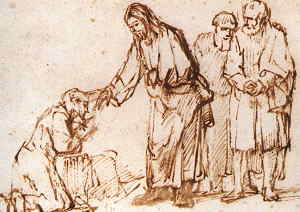
A leper came to Jesus begging him, and kneeling he said to him, "If you choose, you can make me clean." Moved with pity, Jesus stretched out his hand and touched him, and said to him, "I do choose. Be made clean!" Immediately the leprosy left him, and he was made clean. After sternly warning him he sent him away at once, saying to him, "See that you say nothing to anyone; but go, show yourself to the priest, and offer for your cleansing what Moses commanded, as a testimony to them." But he went out and began to proclaim it freely, and to spread the word, so that Jesus could no longer go into a town openly, but stayed out in the country; and people came to him from every quarter. (Mark 1:40-45)
 
God, take away our hearts of stone and give us hearts of flesh.  Amen. 

A few years ago, I was serving as altar assistant and cantor for Wednesday noon services at a small Church in Washington DC.  Most of the people who came were employees from the nearby Department of State.  But I remember one member of the congregation very graphically.  He was clearly disabled by mental illness: he often was unable to care for his basic hygiene needs, and unwilling to seek help.  Most of the other worshippers clustered on the other side of the church away from him, because, frankly, his behavior was bizarre and he smelled very bad.  One priest began to get help for the man’s hygienic and then his medical needs.  The man became belligerent and drew away.  Another priest used later the sacrament as a reward to encourage the man to change his behaviors, with some good results.  He began to take his meds and make his talk-therapy appointments.  

In this, I learnt an important thing.   We in the Church are an odd mix of misfits and walking-wounded.  Those of us most thankful for the grace God has shown us are the most engaged with those still suffering, the most patient with the debasements of others.   They also tend to be the least sentimental, and the least willing to make things worse by engaging in enabling behavior that just delays recovery. 

In today’s Gospel reading, one of the “living dead” appears:  a leper.  He begs to be made clean.


Leprosy in the Bible is probably not merely Hansen’s disease, the highly communicable and, until antibiotics were discovered, hopelessly disfiguring and fatal disease that we call leprosy. In the Bible, it almost certainly includes any fungal or viral disease of the skin like ringworm or athlete’s foot.  Leprosy was highly polluting in terms of ritual impurity, and was to be avoided at all costs for this reason. It was a source of “dirt,” disgusting filth, and was contagiously contaminating.

Lepers were beyond the pale of society.  They lived apart from family, community, or village.  They had to warn others they were even approaching: true pariahs, untouchables.  No one wanted to see them, hear them, or even know of them. 

Jesus as a practicing Jew, believed that the purity rules were God’s commandments.  These included the laws that allowed for lepers, once their symptoms disappeared, to be ritually purged of uncleanness through a small sacrifice, a ritual washing, and a declaration of cleanness by a priest in the Temple. 

The leper says to Jesus, “If you choose, you can make me clean.”    He kneels, and begs Jesus to cure him and remove the ritual uncleanness. 

Jesus’ is deeply moved in reaction.  But the text here is somewhat unclear.  Some manuscripts say Jesus is angry or indignant, presumably at the sight of a person whose situation sums up what is wrong with the world.  Other copies say simply that “his stomach turned.”  The usual translation follows the most common Koine Greek sense of the word and takes this as meaning, “his stomach turned with pity.”  But the original core meaning of the word here in this context suggests another possibility:  “his stomach turned in disgust.”


The sense would be, “Although Jesus’ stomach was turning in disgust, he stretched forth his hand and said to the man, “I do so choose.  Be made clean!”” 

He heals the man and declares him clean, in one act overthrowing all the claims of the Temple establishment and righteous interpreters of the Law.  They claimed that salvation and purity were found only through the orthodox, authoritative religious Temple brand. 

To calm things a bit and keep a lid on the story of miracle-working that had been attracting huge audiences but no congregations, Jesus tells the man to go through the motions of the Law to reclaim legal purity.  But he still has overturned the claims of the Temple rites. 

“Though his stomach was turning, Jesus said, ‘I do so choose. Be healed.’”

Jesus is revolted by the leper.  His religion tells him the man is untouchable.  The commandments of his God tell him that the man is impure, filthy, something to be fled.  Like the man in my old Wednesday parish, the leper was filthy and stank.  He had no business coming near the worship of the Lord in the beauty of holiness.

But for Jesus, mercy and humanity were always more important than purity.  The sufferer in front of him trumped all the sub-clauses of God’s Law. He held his nose, as it were, and still reached out and hugged the smelly wretch. 

This really marks just how radical Jesus was. The religion of the day declared, with the full authority of scripture literally cited and interpreted through authoritative tradition, that impurity was contagious. It spread from the unclean to the clean. People who want to please God must avoid it, lest they commit sacrilege against the Temple of God, the land, and risk God’s wrath.

Despite this, Jesus knew that love and goodness were more contagious than impurity, because of who God was—a loving parent who would always give the child the best food, a wonderful master of the weather who gave the blessings of rain and sunshine to righteous and wicked alike, a merciful friend who would get up in the middle of the night for a friend just because he was knocking at the door.  This is what Jesus preached, and what Jesus lived.  He spent most of his time with the dregs of society:  drunks, traitors, and whores.  “It is the ill who need a physician,” he would said, “not the well.” 

“Though his stomach was turning, Jesus said, ‘I do so choose. Be healed.’”

Despite his revulsion, Jesus chooses to heal the man, even to touch him in the process. 

Love for us Christians is not a condition of the feelings.  It is a state of the will, a choice made by the one who loves.  It is the disposition to serve, help, forgive, and engage for the good of the beloved, whether kindly or fiercely. 

Here in Ashland, land of New Age and Spiritual-but-Not-Religious, we often hear it said, “Trust your feelings.”

I have to say, with some embarrassment, that whenever I hear that, I cringe. 

This is not because I have buried my feelings, cut off emotion, and learned the rigorous discipline of logic and data.  It is because in my experience, feelings can be very dangerous guides to thought and action. 

I have seen far too many families ruined, lives unhinged, marriages and partnerships destroyed, and people put in jail because they were “following their feelings.” 

As a result, whenever I see the first Star Wars movie, when the ghost of Obi Wan Kenobi comes to Luke Skywalker and tells him, “Luke, trust your feelings,” I want to jump out of my chair, and yell, “NO, LUKE!  DO NOT TRUST YOUR FEELINGS.  THEY ARE VERY, VERY DANGEROUS!” 

The adviceto trust feelings is good, as far as it goes.  We process a lot of material at a subconscious level, and our gut intuition sometimes is a very valuable—even a life-saving—factor in crisis situations.  And being authentically in touch with our emotions and able to sort our good ones and not-so-good ones is a crucial skill. 

But the fact is, none of us is perfect, and none of us have perfectly trained consciences or feelings.  We need to learn when and how to trust our feelings to not be misled by them.  And this is done in community.  It is what spiritual direction and retreats is about.  It is what Church is about.  It is what going to group is about—whether therapy or support group, or 12-Step meeting.  One of the things we first learn is how important our feelings are—not as signs of the truth of the world and what we should do, but rather as indicators about what is going on inside of us and of danger areas for us. 

We need never think that our uncleanness is a barrier keeping us from Jesus. We need not fear that a disability we may have can keep us from the love of Jesus.   What keeps us from Jesus is our fear itself. Our fear may make us so nervous that we might not, like this leper, run to Jesus and kneel before him and beg him to heal us. We need to reach out to Jesus and beg him to heal us. 

And then, in thankfulness for his grace, we follow Jesus.  The fact that our stomach may turn, whether in disgust, fear, or trepidation, when we are called upon to do some service of one kind or another, or help a person particularly offensive to us, is not a sign that Jesus is not calling us.  It is a sign perhaps that He is calling us beyond our comfort zone to a good that we could not have aspired to ourselves. 

Disfiguring skin disease is unpleasant.  Smelly and messy lack of hygiene is gross.  But this is what we are called at times to embrace.  And what about HIV/AIDS?  Or nasty, ugly, just plain mean mental illness? Drug or alcohol addiction?  The madness and dementia of old age? 

Like Jesus, we need to choose to heal, to reach out and touch the leper, to choose to welcome the smelly and crazy guest.  This act of choice is what we call love.  And it is where God intersects with human life. 

May we so serve and follow God’s call. 

In the name of Christ, Amen.

Friday, June 17, 2011

Love's Cost (1 Cor 13:1-13)


Love’s Cost
18 June 2011
Wedding of Dale Guy Kreisher and Man Ka Wing
St. John’s Cathedral Hong Kong
Gen 2:4-9, 15-24; 1 Cor 13:1-13; Mark 10:6-9, 13-16

Imagine that I can speak in many human and angelic languages, but that I am a person who does not love anyone.  What I am I then?  Simply a noisy and annoying gong or cymbal, nothing more.  And what if I were a prophet who knew every bit of God’s plan, and every item of knowledge there was to know, and even had such complete faith  that I could move mountains at will.  If I weren’t a loving person—what would I be?  Nothing, that’s what.  If I gave away everything I own—and if I gave over even my body—a praiseworthy thing, to be sure—and yet if I did not have love, it wouldn’t do me any good.    What is love?  When you love someone, you are patient and kind with that person.  You are not jealous of those you love, and you don’t try to show them up.  You don’t talk down to them, or act rudely toward them.  You don’t try ot have your own way at their expense, nor do you get annoyed or resentful at them.  You don’t get pleasure at any injustice done to them or by them, but rather you rejoice when truth prevails.  When you love someone, you put up with whatever they do, you trust whatever they say, you hold every hope for them, and you are willing to endure anything for them.  When you love, you never stop loving.  Not so with prophecies, languages, or knowledge—these will all cease one day.  For our knowledge and our prophecy are partial only.  And when wholeness arrives, partial things will come to an end.  When I was a child, I used to talk, think, and reason as a child does.  When I became an adult, I put aside a child’s way of doing things.  At present, we see things indistinctly, as if through a clouded mirror.  But then it will be face to face.  At present, I know things only in part, but then, I shall have a knowledge of others just as I also am fully known.   But as matters stand now, only these three things really last—faith, hope, and love.  And of these, the greatest is love. (1 Cor 13:1-13)
God, take away our hearts of stone, and give us hearts of flesh. Amen

 
In Chinese, when we talk about someone who is a soul-mate, a true friend—we say we share yuanfen. The idea is that we have a link that goes back to some kind of previous life, back to a whole set of good deeds we may have done one another from before we remember.   In Western romantic literature, this idea is expressed by the phrase, finding your “one and only” true love. It certainly describes the kind of love my parents had—they met in second grade, were best friends, and fell in love as soon as they were in high school. They secretly married when they were seventeen years old, much to the chagrin of their parents. But they remained faithful and true to each other for sixty-some years, until they died.

I never saw them argue, though I often saw them work out differences between themselves.

I once asked my father how it was that you could tell if you had found your one true love, your “one and only.” He looked pained at the question, as if I had missed the point. He said, “it doesn’t really matter if you think you have found your one and only. Many people think they have their one true love, only to discover as they age and change that it was a short-lived emotion, a passing attraction. And their marriages didn’t last. So you shouldn’t ask whether you have found your one and only. You should ask what you need to do
today to make the one you love your one and only. Because you don’t find a true soul-mate—you make one through actions each day.”

I thought my father was being terribly un-romantic. But I knew he was deeply and hopelessly in love with my mother.  And that, after nearly fifty years.

I have come to realize that he was describing the only kind of romance that lasts-- one that is strengthened and renewed each day, through thick and thin, by the actions that show and built mutual respect, love, and passion.

The reading from Corinthians that we just heard is often misunderstood.  Because it is often read at weddings, people think that Paul is talking about romantic love.  But Paul is talking about love itself of any kind.  He says that love is not just an emotion that is felt and experienced, but a condition of the will.  He knows that love as emotion, like any passion, can be fleeting or unpredictable.

“When you love someone, you are patient and kind with that person.  … are not jealous of them… you don’t try to show them up.  You don’t talk down to them, or act rudely toward them.  You don’t try to have your own way at their expense, nor do you get annoyed or resentful at them.  … When you love someone, you put up with whatever they do, you trust whatever they say, you hold every hope for them, and you are willing to endure anything for them.  When you love, you never stop loving.” 

Love here is not just a feeling we experience or suffer.  It is an active way we behave, the way we treat the beloved. 

Love in this sense is a type of sacrifice, a limitation on our freedom and our will. 

In another part of this same letter to the Corinthians, Paul writes that in marriage, we no longer own ourselves, but have given ourselves over to our spouse.    “The husband should give his wife what she needs, and likewise the wife should give her husband what he needs. The wife does not have authority over her own body but yields it to her husband. In the same way, the husband does not have authority over his own body but yields it to his wife.” (1 Cor 7:2-5).   

For Paul, love by definition places constraints on our freedom.  That’s why he says at one point, “In love, be like slaves to one another”(Gal. 5:13).  Paul knows that love is risk, and that love is costly.  It involves constraints, though these are not reducible to mere rules.  

Francoise Sagan, the French novelist, was brutally honest about how love limits freedom in an interview she gave to Le Mond
e.  She said she was satisfied with the way she had lived her life and had no regrets.  The interviewer said, “ Then you have had the freedom you wanted.”  Sagan replied: “Yes… I was obviously less free when I was in love with someone . . . But one’s not in love all the time.  Apart from that, … I’m free.” 

Love is always a risk.  We often are afraid of trusting our fragile hearts to someone else, especially if our heart has been bruised or broken.  But love is a gift from God, and refusing love, not loving, is an option that we take only at the peril of our souls.
C. S. Lewis writes:  “Love anything, and your heart will certainly be wrung and possibly broken.  If you want to make sure of keeping it intact, you must give your heart to no one, not even an animal.  Wrap it carefully round with hobbies and little luxuries; avoid all entanglements; lock it safe in the casket or coffin of your selfishness.  But in that casket—safe, dark, motionless, airless—it will change.  It will not be broken; it will become unbreakable, impenetrable, irredeemable.  The alternative to tragedy, or at least the risk of tragedy, is damnation.”
Today Dale and Ice you are making each other important promises in the presence of God, the saints and angels, family, friends, and colleagues.   The vow which you are taking is to love, comfort, honour, and protect each other, and, forsaking all others, be faithful to each other as long as you both live. 

May God bless you to keep and honor these promises.   Be sure to take time each day to listen to each other.  Be sure to allow each other space.  Be sure to be honest with each other.  Both of you are very demanding people, hardest probably most of all on yourself.  Be kind to each other, and help each other be easier on yourselves. 

Like love, this vow is not reducible to a mere set of rules.  Like Love, this vow demands all, demands perfection.  And no one of us is perfect.  So I also pray, that when your imperfections hurt the other, as they are bound to, May God bless you to seek forgiveness from each other, and to forgive each other.  That, after all, is what love is. 

May your love be a source for you to share God's gifts with others.   Be hospitable, and continue enjoying your friendships.  I hope that God blesses you with children, because I know that both of you desire this, and believe that the two of you will be fabulous parents.  That is part of love as well. 

May the vows you take today make your love firmer, and more alive.  May your marriage last as you both live, and your love and relationship become part of the great eternal dance of light that surrounds the throne of God.  

In the name of God, Amen.    


Sunday, February 20, 2011

In God's Image, All (Epiphany 7A)


In God’s Image, All
20 February 2011
Seventh Sunday After Epiphany Year A

Leviticus 19:1-2,9-18; 1 Corinthians 3:10-11,16-23; Matthew 5:38-48; Psalm 119:33-40

Jesus said, “You have heard that it was said, ‘An eye for an eye and a tooth for a tooth.’ But I say to you, Do not resist an evildoer. But if anyone strikes you on the right cheek, turn the other also; and if anyone wants to sue you and take your coat, give your cloak as well; and if anyone forces you to go one mile, go also the second mile. Give to everyone who begs from you, and do not refuse anyone who wants to borrow from you.

You have heard that it was said, `You shall love your neighbor and hate your enemy.' But I say to you, Love your enemies and pray for those who persecute you, so that you may be children of your Father in heaven; for he makes his sun rise on the evil and on the good, and sends rain on the righteous and on the unrighteous. For if you love those who love you, what reward do you have? Do not even the tax collectors do the same? And if you greet only your brothers and sisters, what more are you doing than others? Do not even the Gentiles do the same? Be perfect, therefore, as your heavenly Father is perfect.”
  Matthew 5:38-40

God, take away our hearts of stone, and give us hearts of flesh.  Amen

In today’s Gospel, Jesus teaches us, “Love your enemies. Pray for those who persecute you. To be perfect as God is, don’t reserve your good wishes and love only to your own kind, to those who love you and wish you well.”   He says we are not to use violence to retaliate for violence, and gives three examples:  “If someone strikes you on the right cheek, turn to him also the other one.   If someone sues you for your outer garment, give to him your inner one as well.  If a soldier compels you to carry his gear for one mile, carry it another one as well.”  

Does Jesus here mean for us to not try to respond to situations of abuse?  Is he encouraging a passive victimhood?  By the beginning of the second century, it was common for Christians to pass on Jesus’ teaching as it they were rules for winning God’s favor and eliminating one’s defects.  Some early Christians used today’s passage as if it were a guidebook of how to become “perfect.”

One of the earliest accounts we have for the order of the Eucharist, the Didache, or Teaching of the Twelve Apostles, dates from shortly after the year 100 C.E., the time that the Revelation of John was written.  In it, we read,    

“There are two ways: one of life and one of death; and the difference between the two ways is great. The way of life is this: first, you should love God, who made you; secondly, love your neighbor as yourself; and whatever things you do not desire to be done to you, do not do them to someone else. Now the words of this teaching are this: Bless those who curse you and pray for your enemies, and fast for those who are persecuting you. For what credit is it if you love those who love you? Do not the Gentiles do the same thing? But love those hating you, and you will not have an enemy. Keep yourself from fleshly and bodily cravings. If anyone hits you on the right cheek, turn the other one to him also. And you will be acting maturely. If someone should force you to go one mile, go with him two. If someone takes your coat, give him your shirt also. If anyone should take from you what is yours, do not demand that he give it back, for you cannot. … Blessed is the one who gives according to the commandment, for he is innocent.
… Assemble yourselves together frequently to seek the things that benefit your souls, for all the time of your faith will not profit you unless you are perfect at the last.”
 (Didache, chapter 1, chapter 16). 

Despite its early pedigree, this way of reading these sayings—turning them into moral rules for us to gain the approval of God—weakens, I think, what Jesus was actually arguing. 

The Greek word here for “perfect” is teleios.  This means “in conformity with your telos,” or intended purpose.  Rather than primarily meaning “without defect or flaw,” it means “in accordance with what God intended when he created you.”  The Aramaic word that Jesus probably actually used, tam, had roughly the same semantic scope.  The point is fullness of life, shalom, in keeping with all of the intentions of a good and loving Creator, the Creator who made “humankind in his own image.”  Just as God gives the blessing of rain to good and bad alike, so should you, who bear God’s image, reflect God’s beneficence and intend good things for all of God’s other creatures who bear his image.  In order to be the person God intends, you need to surpass “fair,” you need to go beyond mere “justice.”  He introduces an idea of treating all people, regardless of whether they are good or bad, with the dignity and worth that they possess because they bear the image of God. 

Jesus starts by saying, “You have heard that it was said, ‘An eye for an eye and a tooth for a tooth.’   He is quoting here from the Torah’s rule that vendettas and vengeful escalation of violence should not be pursued, the lex talionis or the law of measured retaliation. Wherever harm is committed—whether intentional (Leviticus 24:20) or deliberate (Exodus 21:24)—the Law said the response was not to surpass the original damage committed.  You could put out the eye of someone who had put someone else’s eye out (an "eye for an eye") but not take their life.   The principle is one of proportional response, and of punishment fitting the crime, and embodies what the Torah sees as justice (Deuteronomy 19:21). 

But Jesus says that in order to enjoy fullness of life, we should be more than merely just.  We should not respond to violence with violence.  Jesus proposes another strategy for dealing with evil:  overcome it with good, one way or another. 

This is not a teaching of passive submission to abuse.  It is more like the idea of Satyagraha, or Truth Force, which Gandhi developed from this very saying of Jesus, or of peaceful active resistance or direct action developed by the Rev. Martin Luther King, Jr., who also worked from this very text. The goal is to overwhelm the evildoer by an exposing of the evil through a show of good.  In the shame-based society in which Jesus lived, he advised that we respond to humiliation by shaming those who abuse power.  We should respond to an unjust loss of face by forcing a just loss of face.  And this is done precisely through the mechanism of not stooping to the level of the abuser.  
Walter Wink (in Naming the Powers) has done us all a favor by noting a crucial detail in the text—“if someone strikes you on the right cheek.”  In that society, you only would have used your right hand for interacting with others.  So mentioning the fact that it is the right cheek that is being struck implies a haughty overlord giving a brutal but dismissive backhanded blow to someone seen as much lower in the social pecking order.  Jesus says “Don’t strike them back.  Instead, stand up tall and turn, forcing them to use their open palm on your left cheek as they would a social equal.”  In Chinese terms, we would have added—“thus making him lose face.” 

Jesus uses a second example of his strategy for engaging people with God-like good will.    “If a creditor sues you for your outer garment, give him your inner garment as well.”    The outer garment was used for warmth and as a cover at night.  The inner garment could be worn alone without shame, but there were no underclothes beneath it.   By saying “throw in your inner garment as well,” Jesus was saying to strip naked before the creditor, shaming him before all and revealing the true dynamic of the exploitative system of large landowners forcing all small farmers off their land.   (It was only because these ancient middle-easterners “went commando” that he could argue for such “guerrilla theater.”)

The third example Jesus gives is being compelled to carry baggage for the Roman Army.  The Roman Military had the right to force local people to carry their substantial baggage.  Remember how in the Passion narrative they simply compel a passerby—Simon of Cyrene—to carry the crossbeam for Jesus’ cruxifixion when Jesus himself collapses under the task.   But abuse of this right produced situations where riots might break out when a large group of people thus impressed found themselves a day’s walk back to their homes.  So the authorities had issued a limitation—only one mile, a thousand broad paces, was allowed.  There are recorded cases of severe punishments being meted out to Roman legionaries who broke this rule and provoked unrest.  “If you are impressed to carry baggage a mile, walk on another mile as well.”  One can imagine the humorous situation of the soldiers, afraid of breaking regulations and being punished, begging with a head-strong follower of Jesus to please lay down his load after the required 1,000 steps.  Again, an insult and demeaning is turned on its head by an aggressive, but peaceful act. 

Jesus here is teaching that God is above the fray in some ways, and very actively involved in others.  And we must be similarly detached (not following a gut instinct to react in kind) but all the while very, very actively engaged. 

The reason for this is simple.  The opposite of love is not hate.  The opposite of love is indifference, cold, uncaring indifference.  Jesus wants us engaged and actively responding to evil with the same active love of the loving, but sometimes perhaps bothersome God who has sought us out and found us.  He wants us neither to hate nor to be indifferent.  He wants love, burning, attractive, painful love. 

A common and traditional way of seeing Jesus in these verses is thinking that he taught his disciples to be docile and accepting victims of abuse.  If that were so, one of the few historical facts that we actually know with certainty about his life—his execution at the hands of the Roman authorities—makes little sense.  If he taught gentle and tidy submission to all authority, even abusive authority working against God’s purposes, it is highly unlikely the Romans would have used crucifixion to kill him.  This particularly brutal and refined form of public torture and slow suffocation was the punishment they reserved for those found guilty of sedition and rebellion, a charge that is certainly implied by the title they fixed over Jesus’ writhing nailed body, “King of the Jews.”   Had Jesus simply taught acceptance and peaceful submission, the Romans probably would have let him pass him as an odd, but welcome voice that helped them maintain control of their restive Empire.  But that was not the case.  They basically put him to death for disturbing the order of things, for subverting in sayings like these the basic social order of an Empire.  The Romans put Jesus to death because he taught that the value of each of every person was greater than the need to maintain proper Primate grooming rituals in a military dictatorship.  

I heard the best sermon I have ever heard in my life here in Beijing in the late summer of 1989.  It was by a layman in a House Church, and it was on a text from today’s Gospel. 

During the somewhat liberal period of religious openness in China prior to the June 4, 1989 crackdown, local Chinese had begun attending services with expatriates. After the crackdown, the Chinese security and political control apparatus was brought to bear on Beijing’s Chinese Christians as well as any other group seen to be too closely identified with foreigners.  Old rules that had remained on the books forbidding Chinese nationals from attending “foreign” worship services started to be enforced with a vengeance, rules that are with us still. The pressure brought to bear on our Chinese congregants became almost unbearable. Finally our congregation decided that the local people and the expatriates in our congregation would go their own ways and worship separately.  The secular law, previously somewhat murky, had become clear, and we intended to obey it.  It was very hard on all of us, because we had become close friends.       


One of these Chinese members of our congregation spoke at the last service we held together. He started his sermon, in Chinese, by noting that separate worship would be hard, since “gathering together each week is like drawing individual pieces of firewood together, to make a blaze that can warm us through the week.”  Pulling apart the critical mass of fuel for the fire posed the risk of extinguishing the flame, especially if the individual pieces of fuel were isolated, put aside, and kept alone in the cold, where their flame would die for want of heat. But we had no real choice in the matter, given the pressures that were being brought to bear. 

My friend took as his text Matthew 5:44: “But I say to you, love your enemies, and pray for those who persecute you.”   He said he had always thought that this was a little over-dramatic, “for why should Christians have enemies?” he said he now understood the passage much better.    “If I could be so bold, I’d like to refer to a passage in Alexander Solzhenitsyn’s Gulag Archipelago.”  Since in all probability our meeting place had listening devices in the walls, most of us shifted uncomfortably. 


He continued.  “In this book, Solzhenitsyn is the labor camp system in the Soviet Union.  He becomes more and more dehumanized by his torment, but then, in a chapter called ‘Resurrection,’ regains his Christian faith and begins the long road to true freedom, even within that system.  In the key passage of that key chapter, Solzhenitsyn says that he realized at that critical time that no matter how tightly his interrogators constrained him, he always had a choice—though they always eventually could force him to say what they wanted, he could do so willingly or unwillingly, cheaply or expensively in terms of the suffering he endured before giving them what they demanded. 


Police photograph of Solzhenitsyn, 1953.

“He also realized that the too were constrained to do what they did, and that they too had a choice in how they did what they were constrained to do.  In a system where all were compromised and all were victims in one degree of another, he realized the great truth that the line between good and evil is not found between one country and another country, between one economic class and another, between one political party and another, between one religion or another, or one race and another.  The line between good and evil, he says, is fine but very definite, and runs down the middle of each and every human heart.  It is found in that space of the heart where we exert our choices, no matter how constrained our choices may be. 

“So Solzhenitsyn realized that he needed to pray for his interrogator, and for all of God’s creatures, even Stalin. It is where my faith begins as well.  This is the reason, I believe, that we must pray for our enemies.  They, like us, are in God’s image, and have that line down the middle of their hearts, no matter what decisions they have made before, no matter how distorted the image of God may have become in them, or how twisted or constrained the options left to them might be.

“So we must pray to the creator to help his creatures–not that they be like us, not that they treat us more favorably, not that they choose what we wish they would choose, but that in whatever way God wants, here and now, they might opt for the good in their hearts and not the evil.  We pray that they might become what God created them to be, not what we think that they should be.  We do this because we share with them in our hearts the capacity to do great evil or great good.  Without such a belief in my solidarity with all my fellow creatures, even those who persecute me and what I believe is good, I would not have hope that God might work his miracles in my own heart, and help me to choose the right.  That is why I must pray for even Premier Li Peng, who imposed martial law, and for all who ordered the military actions during the first week of June.

“Jesus was perhaps establishing an impossible standard for human behavior and emotions in the sermon on the Mount, when he said love your enemies.  But as he said elsewhere, with God nothing is impossible.  God gives us the grace to be able to pray sincerely for our enemies’ good.  For we must do this if we are to become as God wants us.” 

That sermon changed the way I looked at many things, and is one of the great watershed moments in my life, the moment, I believe, where I started on the journey of cultivating an adult Christian faith shorn of sectarianism.  Particularly because of the circumstances in which it was given, it brought together for me many of the disparate elements of my religious belief and helped me internalize them.

My friend and Solzhenitsyn both understood the principle behind Jesus’ statements here. We are all God’s creatures and all bear God’s image, no matter how we may have distorted and twisted it. And so are all who are our enemies.  We are all in this together. And that is so regardless of what we think of each other, regardless of how right or wrong we may be in our judgments of each other.

God loves us, each and every one.  So we must learn to love each other.  Not pretend to love each other.  Not practice passive aggression on each other as we despise the other.  Not silently disengage and passively submit, detached, from the abuses others subject us to.  But love.  And love as God loves, which means sometimes being a pain in the neck and almost always means challenging the beloved. 

I pray that we may learn so to lovingly, actively engage those around us.  

In the name of Christ, Amen.   

Saturday, December 25, 2010

What Sweeter Music (Chrismas Daily Office Year 1)

 
What Sweeter Music?
25 December 2010 
Daily Office Christmas Year 1
Zech 2:10-13; 1 John 4:7-16; John 3:31-36


Beloved, let us love one another, because love is from God; everyone who loves is born of God and knows God. Whoever does not love does not know God, for God is love. God's love was revealed among us in this way: God sent his only Son into the world so that we might live through him. In this is love, not that we loved God but that he loved us and sent his Son to be the atoning sacrifice for our sins. Beloved, since God loved us so much, we also ought to love one another. No one has ever seen God; if we love one another, God lives in us, and his love is perfected in us. By this we know that we abide in him and he in us, because he has given us of his Spirit. And we have seen and do testify that the Father has sent his Son as the Savior of the world. God abides in those who confess that Jesus is the Son of God, and they abide in God. So we have known and believe the love that God has for us. God is love, and those who abide in love abide in God, and God abides in them. (1 John 4:7-16)


God, take away our hearts of stone, and give us hearts of flesh.  Amen

“Everyone who loves is born of God and knows God; … those who abide in love abide in God, and God abides in them.” 

We often miss the point of these phrases in the first letter of John.  We tend to turn them on their head and read them as if they say “whoever knows God and is born of God learns how to love, and those who abide in God and in whom God abides practice love.”  We might be lead to do so by the fact that the passage says “God abides in those who confess that Jesus Christ is the Son of God” 

But this text argues in the opposite direction—the author says the practice of love brings about and embodies personal closeness to God, not the other way around.   The distinction is an important one, since we generally tend to think that the experience of love in some form or another is more generally common and shared among human beings than is having knowledge of God or being born of God, particularly when we associate such “God-talk” with submission to a particular religious tradition. 

The “love” referred to here, of course, is not just our love for other human beings: “God's love was revealed among us in this way: God sent his only Son into the world so that we might live through him. In this is love, not that we loved God but that he loved us and sent his Son.”  

This is not an argument that we simply “confess Jesus as Lord” with our lips and “God will take care of everything.”   For 1 John, love comes first, and God’s action in our lives takes care of the rest, including the personal attachment to Jesus that he says from his experience is at the heart of having abiding love.  This is not a sectarian call to sign up for a doctrinal program or a partisan religious affiliation.   It is a call to love and trust, with all that those words imply.  And he bases this call on the fact that God sent Jesus, i.e., that God took on flesh and became truly human.

At root here is a key element in classic Christian theology of the incarnation.   Christians have long reflected on what it means when we say, together with the Gospel of John that “the Word of God took on flesh and became truly human.”

That God somehow took on flesh and became truly human marks a radical continuity between our human lives and God’s, and that implies a sacredness in all it means to be human.   Human love, friendship, the enjoyment of the simple pleasures of our world, and even our sorrows and pain—all these are taken up into God the moment God takes on our flesh.  As one of the great theological doctors of the Eastern Church, Saint Athanasius, wrote: “[God], indeed, assumed humanity that we might become God.” (De Incarnation 54). 

We often miss the point, wrongly thinking that somehow God came among us without truly being one of us. This “God incognito” paid for our sins and somehow made it possible for us to be more like God, and less like human beings.  That is a total warping of the meaning of the incarnation.

God became truly human in all ways (except in resisting God), and that means it’s O.K. to be fully human.  In fact, it means God calls us to be fully human, and to do that he calls us to follow his example when he was among us, and not resist God so much. It is only thus that we can find our true and full humanity.
We often hear this time of year calls to “put Christ back in Christmas.” People complain about commercialization, too much partying, and not enough praying.  This phrasing of the question gets the issues all wrong. It separates the partying and celebration from spirituality. Granted, some people see the holiday solely as a consumer or marketing event. The holiday is thus diminished, often becoming a source of stress and depression.

The problem, however, is not too much celebration, but too little. “I will greatly rejoice in the LORD, my whole being shall exult in my God” says Isaiah. It is not just “the spiritual side” of us that should rejoice. To want to turn Christmas into a sectarian prayer meeting rather than the public, boisterous, and commonly shared party that it currently is—regardless of beliefs—stems from bad theology.


In the history of the Church in England, this issue once came to a real crisis point and literally caused the government of England to “cancel Christmas” for two decades.  After the English Reformation, some Christians there believed that the Church had not been reformed thoroughly enough, that it was not sufficiently “biblical,” and that it still was corrupted by what the early reformers called “the enormities of Rome.”  They wanted to get rid of fancy vestments, bishops, organs, and even the daily or weekly celebration of the Eucharist itself.   These Puritans focused their political activism in Parliament on eliminating corruption and privileges of the Royal Court and the nobility, including the bishops, whom they tended to call “certain popish persons.”  

When the Army raised by Parliament won the Civil War, the Puritan regime that came into power was narrow, fundamentalist, and harsh, somewhat like an English Taliban.  They banned Prayer Book worship and bishops, and set into Law a whole range of austere measures aimed at purifying the country.

One of these measures banned the celebration of Christmas.  Its very name—Christ’s Mass—was far too Roman for the Puritans’ tastes.  The fact that is was marked by twelve days of mid-winter partying, singing, drinking, and, for the more religious, Eucharists, were equally distasteful.  Special church services, mince pies, hanging holly, big parties were banned from 1644 to 1660.

Now in fairness to the Puritans, it must be said that they were rightly concerned at the excesses of some of the partying:  then, as now, serious public drunkenness and debauchery were among the abuses attendant to the celebration of the season by some. 

 Sir John Hutchinson

(I feel the need here to be fair to the Puritans.  One of my ancestors, Col. John Hutchinson of Nottingham Castle, was one of the “Parliament men” who signed the death warrant of King Charles I after Charles was tried and found guilty of war crimes and mass murder.  Col. Hutchinson, concerned with the excesses of the Court of Charles I, had initially supported the Roundhead Army in opposing the “King’s men” or Cavaliers.  But he was spared a traitor’s execution after the restoration of the monarchy because he equally opposed  the excesses of the Puritan regime headed by Lord Protector Oliver Cromwell and had prevented retaliatory war atrocities being perpetrated on Cavalier prisoners of war.  The fact that his wife Lucy’s father was a royalist nobleman who helped in restoring the monarchy after the Commonwealth did not hurt either.  Despite the fact that the Puritans “won the war but lost the peace” only to have the monarchy restored, the whole affair changed the nature of the British crown, and prevented in England the kind of traumatic revolution that happened in France in 1789.   Many of the political ideas and slogans of the Roundhead puritans were taken up part and parcel by the American revolutionaries in 1776.)   

The Puritans, throwing away the baby Jesus with the bathwater of overdoing it in Christmas partying, banned the holiday outright.  “Christmas is a pagan celebration,” they said, “and must be done away with by true Christians.”

Note the theology at work here—it was exclusionary, not inclusive:  “true Christians” needed to show their “trueness” (and, in so doing, point out who were “false” Christians and pagans).  It shows a contempt for many of the simple pleasures shared by people regardless of their belief or tradition.   It gets the "first love, then know Jesus" process described in 1 John backward. 
 
At Midnight Mass last evening at the American Cathedral in Paris, I was moved very deeply when the choir sang John Rutter’s setting of a modern adaptation of a poem by Cavalier poet Robert Herrick written just after the monarchy and Christmas celebrations were restored.  Herrick, an Anglican priest who had lost his living during the Parliamentary interregnum, wrote the poem for a Christmas party of the newly-restored King.  In it he argues for the celebration of Christmas against the position taken by the Puritans, and he does so wholly on religious and theological grounds.  He uses good incarnational theology:  the sacredness of all of human life , love, and enjoyment in the wake of God becoming flesh.    I love the poem, and have sung it with other choirs over the years:


What Sweeter Music

What sweeter music can we bring
Than a carol, for to sing
The birth of this our heavenly King?
Awake the voice! Awake the string!
Dark and dull night, fly hence away,
And give the honor to this day,
That sees December turned to May.

Why does the chilling winter’s morn
Smile, like a field beset with corn?
Or smell like a meadow newly-shorn,
Thus, on the sudden? Come and see
The cause, why things thus fragrant be:
‘Tis He is born, whose quickening birth
Gives life and luster, public mirth,
To heaven, and the under-earth.

We see him come, and know him ours,
Who, with his sunshine and his showers,
Turns all the patient ground to flowers.
The darling of the world is come,
And fit it is, we find a room
To welcome him. The nobler part
Of all the house here, is the heart.

Which we will give him; and bequeath
This holly, and this ivy wreath,
To do him honour, who’s our King,
And Lord of all this revelling.

What sweeter music can we bring,
Than a carol for to sing
The birth of this our heavenly King?

--Robert Herrick (1591-1674)


May we all during this season sing, eat, drink, and love each other well.  Let us reconcile with each other and mend family and friend relationships that have gone bad.  Let us celebrate with our whole being, since in Christ our whole being is being made one with God.   Let’s not begrudge our neighbors who celebrate and love without recognizing the source of their joy and love, the source that our experience tells us is God made flesh in Jesus Christ.  Merry Christmas, one and all.

In the name of God,  Amen.